A US or European GTM strategy won’t transfer to the Middle East as it is. The blueprint behind it assumes three things the Gulf doesn’t give you: remote selling that carries the early deals, one base you can spread from, and proof that travels with you. Some of it still works. The sequence, the entry options and the moment you need people on the ground all change.
In this article
- The home blueprint is always the same: land where it’s easy, then spread
- What stays the same in the Gulf, and what changes?
- There are seven ways in, and most companies need a mix
- When do you stop selling remotely and put someone on the ground?
- Full speed or step by step: match the commitment to the evidence
- How you pay when you copy-paste the blueprint
Key takeaways
- 86% of US software companies land in the UK or Ireland first. The Gulf equivalent is the UAE.
- Remote selling validates Gulf demand. It rarely closes an enterprise deal.
- Saudi Arabia is its own market entry, with its own rules. Dubai doesn’t cover it.
- Move someone to the region on evidence. Four triggers tell you when.
- Budget for 24 to 36 months. Twelve-month plans exit just before deals mature.
The home blueprint is always the same: land where it’s easy, then spread
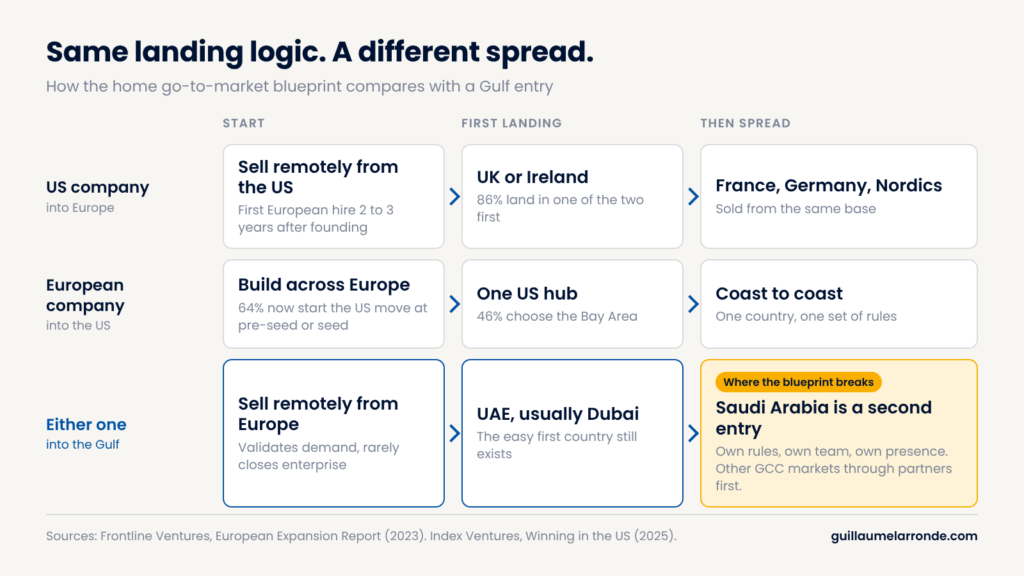
Every expansion plan I’ve seen runs on the same logic. Pick the easiest landing spot, prove the motion there, then spread.
For a US software company, that spot is almost always the UK or Ireland. Frontline Ventures studied 210 VC-backed B2B software companies that expanded into Europe, and 86% set up their first presence in one of those two countries (European Expansion Report, 2023). Same language, familiar contracts, and a base to sell into the rest of Europe.
The timing in that report is patient:
- First European employee: two to three years after founding
- First European office: about six years in
- Two more European locations: around 18 months after the first office
European companies run the mirror image. They spread across Europe first, then cross the Atlantic. Index Ventures found that 64% of the startups it tracked now begin US expansion at pre-seed or seed, and 46% pick the Bay Area as their hub (Winning in the US, 2025).
Inside the US it’s simpler still. You start in one city and spread, and it’s the same country the whole way.
I’ve been on both ends of this. In 2010 I joined LinkedIn, a US company, as its first French sales hire. In 2012 I moved to Dubai as one of three people on the founding team for LinkedIn Middle East.
Looking back, the blueprint rests on four assumptions:
- An easy first country: shared language, familiar law, close enough to HQ.
- Remote selling carries the early deals: you sell from home before anyone moves.
- One base serves many markets: land once, then spread from it.
- Your proof travels: home logos and references open doors next door.
In the Gulf the first one holds. The other three don’t, or not in the same way.
What stays the same in the Gulf, and what changes?
More stays the same than people expect. I’d keep all of this from the home playbook:
- Positioning first: market entry is a positioning problem before it is a sales problem.
- A narrow ICP: named accounts you can reach, not “the Middle East”.
- A beachhead: one country, proven, before the next.
- A builder as first hire: someone who has created a market, not inherited one.
- First customers as proof: the first client in a new market is proof the motion works. Everything before it is theory.
The beachhead even has a local equivalent. Dubai plays the role London or Dublin plays for a US company in Europe. Dubai International Chamber alone attracted 373 companies to the city in 2025, 64 multinationals and 309 SMEs, up 80% on the year before (Dubai Media Office, 2026).
What changes is everything after the landing.
| Blueprint element | At home | In the Gulf | Gap |
|---|---|---|---|
| First landing | UK or Ireland, or one US hub | UAE, usually Dubai | Small |
| Remote selling | Carries the early deals | Validates demand, rarely closes enterprise | Large |
| Spreading out | One base, many countries | Each country is its own case | Large |
| Partners | A choice | Often the way in | Medium |
| Trade shows | A marketing line | A revenue channel | Medium |
| Buying sequence | Use case, then relationship | Relationship, then use case | Large |
| After the business yes | Contract and signature | Security, vendor registration, PO, payment | Large |
Four of those seven gaps are large. Here are the two that catch most teams.
Remote selling validates. It rarely closes.
The home blueprint leans on a buyer who’s happy to buy without meeting you. Gartner found 61% of B2B buyers prefer a rep-free buying experience (2025). McKinsey’s B2B Pulse puts it at roughly a third in person, a third remote and a third self-serve at any buying stage (2024).
Here’s the thing. Those buyers already know you. In 6sense’s 2025 study, 75% of buyers personally knew a seller at one of the vendors they evaluated. At home the relationship is already there when the remote motion starts.
In the Gulf it isn’t. When we opened LinkedIn in Dubai in 2012 we had no enterprise brand recognition and no regional playbook, and the HQ motion didn’t account for how much relationships drive buying here. The region needed a different order: relationship first, use case second, procurement third.
You can’t scale down a headquarters playbook and call it localisation. It’s like translating a book with a dictionary. Every word is technically correct, and nobody wants to read it.
Saudi Arabia is not an extension of Dubai
In Europe a London base can sell into Paris and Berlin. A Dubai base doesn’t cover Riyadh the same way.
- Government access: since 1 January 2024, Saudi government entities are restricted from contracting with multinationals that have no regional headquarters in the Kingdom. Exemptions formalised in 2026 include purchases under SAR 1 million.
- The sales team: from 19 April 2026, sales and marketing roles carry a 60% Saudization rate in firms with three or more people in them.
- The response so far: 660 foreign companies had set up regional headquarters in the Kingdom by September 2025, past the 2030 target of 500.
Confirm the detail with your advisers. The commercial point is that no home blueprint has a line for either rule.
There are seven ways in, and most companies need a mix
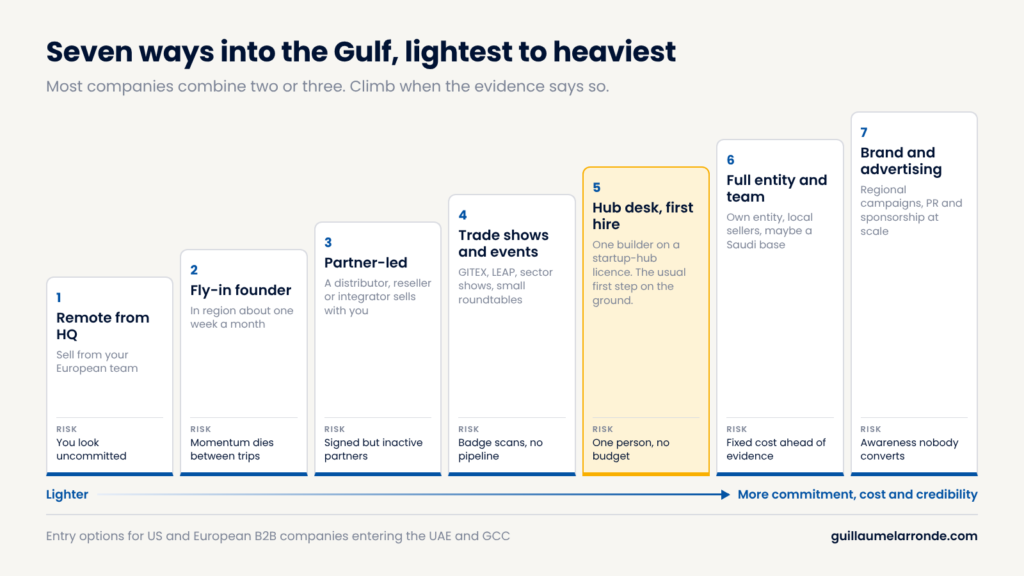
Direct or indirect, online or in person, slow or fast. You don’t pick one. You combine them, and the right mix depends on deal size and who signs.
| Entry option | What it is | Fits best | Main risk |
|---|---|---|---|
| Remote from HQ | Selling from your European team, nobody in region | Validation, mid-market tech buyers | You look uncommitted |
| Fly-in founder | An executive in region about one week a month | First strategic accounts and partners | Momentum dies between trips |
| Partner-led | A distributor, reseller or integrator sells with you | Government and large enterprise access | Signed but inactive partners |
| Trade shows and events | GITEX, LEAP, sector shows, small roundtables | Meeting many buyers in one week | Badge scans, no pipeline |
| Hub desk, first hire | One builder on a startup-hub licence | A proven ICP that needs presence | One person, no budget |
| Full entity and team | Your own entity, local sellers, maybe a Saudi base | Proven demand, Saudi government buyers | Fixed cost ahead of evidence |
| Brand and advertising | Regional campaigns, PR and sponsorship at scale | Broad markets with funding behind them | Awareness nobody converts |
A rough guide by business model:
- Self-serve or low-ticket SaaS: go online first, add resellers, use one event to test.
- Mid-market SaaS: remote plus fly-in, then a hub desk once deals stall without presence.
- Enterprise and government: be on the ground early, with a partner, and plan for Saudi Arabia.
I’ve compared the setup choices in detail, hubs included, in Middle East go-to-market strategy: preparing a GCC entry.
Direct gives you control. Indirect gives you access.
At home, partners are a choice you make later. In the Gulf they’re often the way into government and large enterprise accounts.
That doesn’t mean handing the market over. Sign few partners. Give each one a joint account plan. And count only those that sourced or co-sold qualified pipeline in the last 90 days.
Trade shows are a revenue channel here
GITEX Global 2025 drew more than 6,800 exhibitors from 180 countries (GITEX, 2025). LEAP 2026 in Riyadh had more than 1,500 (Arabian Reseller, 2026).
A stand on its own does very little. What works is 15 or more meetings booked before you land, a small dinner, and a follow-up within 48 hours. Measure pipeline per event dollar.
Sales and marketing land together
Frontline’s report found half of US companies still had no European marketing resource a year after landing. The same mistake travels east.
A seller with no regional marketing spends every first meeting explaining who you are. The minimum is small:
- A regional page and two or three local customer stories
- Executives active on LinkedIn, in a country with 10.0 million registered members and 11.4 million residents (DataReportal, 2025)
- One or two events a year, run as a campaign
- Content an AI assistant can find, since 70.1% of UAE working-age adults use generative AI (Microsoft, Q1 2026)
AI helps with research and the first draft of prospecting. It doesn’t replace the introduction.
When do you stop selling remotely and put someone on the ground?
On evidence, never on a date. Sell remotely to validate, fly in to open accounts, and move someone when the deals tell you to.
Remote works better from Europe than most people think, because of the clock:
- Dubai: three or four hours ahead of London, two or three ahead of Paris and Berlin.
- Riyadh: one hour behind Dubai.
- New York: eight or nine hours behind Dubai, which is why US companies usually cover the Gulf from their European base.
The week is different too. UAE federal government works Monday to Friday, with Friday a half day. Saudi Arabia’s weekend has been Friday and Saturday since 2013, so its week runs Sunday to Thursday. A London team selling into Riyadh shares four working days.
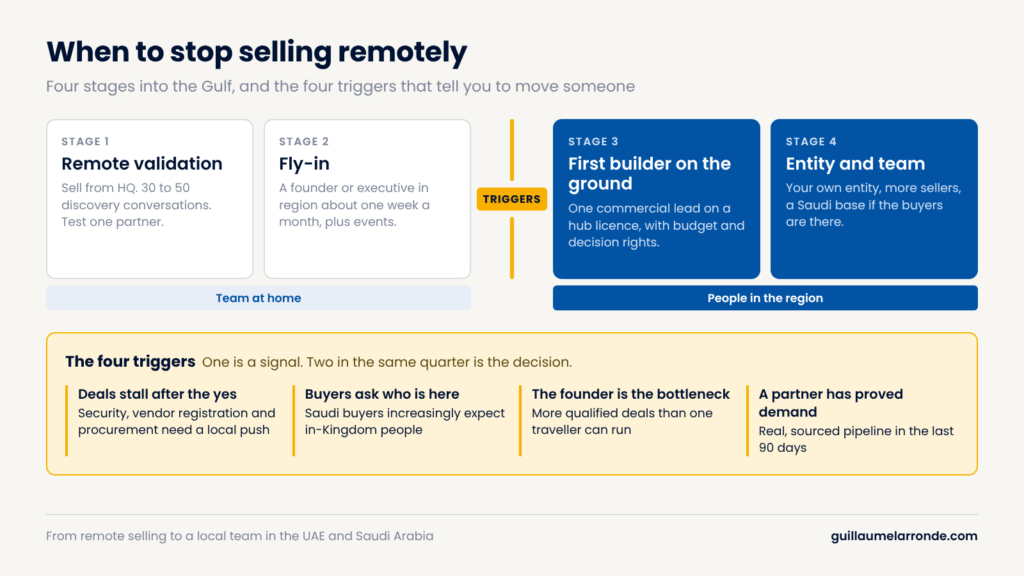
I think of the path as four stages:
- Remote validation: sell from HQ, run 30 to 50 discovery conversations, test one partner.
- Fly-in: a founder or executive in region about one week a month, plus events.
- First builder on the ground: one commercial lead on a hub licence, with budget and decision rights.
- Entity and team: your own entity, more sellers, a Saudi base if the buyers are there.
Four triggers tell you it’s time to go from stage two to stage three:
- Deals stall after the business yes: security reviews, vendor registration and procurement need someone local to push them.
- Buyers ask who is here: Saudi buyers in particular increasingly expect in-Kingdom people.
- The founder is the bottleneck: there are more qualified deals than one travelling executive can run.
- A partner has proved demand: real, sourced pipeline in the last 90 days.
One trigger is a signal. When two show up in the same quarter, I’d stop debating and move someone.
And one person is not a market entry. The first builder needs a pod behind them: an executive sponsor at HQ who travels monthly, a solutions engineer, and marketing and customer success working regional hours.
Presence matters at home as well. More than 70% of the founders Index Ventures surveyed said in-person presence mattered during their US launch. The Gulf just raises the bar.
Full speed or step by step: match the commitment to the evidence
My default is step by step. Building a business in the GCC takes 24 to 36 months, and the early evidence is cheap to collect remotely.
Full speed is the right call in two cases. You already have pull, such as inbound demand or existing customers with Gulf subsidiaries. Or your buyers are Saudi government entities, where presence is the price of entry.
| Pace | When it’s right | How it fails |
|---|---|---|
| Step by step | Unproven demand, mid-market deals, limited runway | A permanent pilot that never looks committed |
| Full speed | Proven pull, customers already in region, government buyers | Fixed cost ahead of evidence |
Both failures happen at home too. Frontline lists expanding too rapidly and moving too late among the mistakes US companies make in Europe.
The Gulf adds one of its own. Companies that budget for 12 months often leave just before their deals mature.
How you pay when you copy-paste the blueprint
The bill never arrives as one line. It shows up as time, people and reputation, usually in that order.
| Copy-paste mistake | How it shows up | What it costs |
|---|---|---|
| Remote-only for too long | Warm meetings, no signatures | A year of pipeline that never closes |
| One regional lead, no budget or decision rights | A rented business card | The hire, and your first impression |
| Treating the Gulf as one market | A Dubai plan applied to Riyadh | Lost government deals, a rebuilt team |
| High-volume outbound | Irrelevant messages to a small set of names | Accounts you can’t reopen |
| A 12-month budget | Exit just before deals mature | Everything spent so far |
| No regional marketing | Sellers introducing the company in every meeting | Longer cycles and fewer references |
The people cost is the one boards underestimate. Frontline found 47% of EMEA general managers at US software companies leave within two years. That’s in Europe, where the blueprint is supposed to work.
From experience, the causes repeat. I spent seven years inside more than 20 commercial engines across Europe and the Middle East, and it was almost always the same four:
- Unclear positioning
- Undefined process
- Misaligned incentives
- A leader measuring effort instead of outcomes
A copied blueprint imports all four and adds distance.
The reputation cost is the slowest to show and the hardest to fix. References travel fast in a market this connected. So does a bad first impression.
Frequently asked questions about GTM strategy in the Middle East
Can I sell into the Middle East remotely from Europe or the US?
Yes, to start. From Europe you share most of the working day with Dubai and Riyadh, so remote selling works for validation and mid-market deals. From the US the time gap is eight hours or more, so most companies cover the Gulf from a European team. Enterprise and government deals usually need presence to close.
When should a startup open an office in Dubai or Riyadh?
When the deals call for it. Watch four triggers: deals stalling after the business yes, buyers asking who is local, the founder becoming the bottleneck, and a partner proving demand. Two in the same quarter is the signal. Start with a desk in a startup hub before you sign a lease.
Should I enter the Middle East through partners or sell direct?
Most companies need both. Direct selling gives you control and teaches you the market. Partners give you access, especially to government and large enterprise accounts. Sign few, build a joint account plan with each, and count only the partners that sourced or co-sold qualified pipeline in the last 90 days.
Are trade shows like GITEX and LEAP worth it for a startup?
They can be, if you treat them as a campaign. GITEX Global 2025 had more than 6,800 exhibitors, so a stand alone gets lost. Book 15 or more meetings before you travel, host a small dinner, follow up within 48 hours, and measure pipeline per event dollar, not badge scans.
How is expanding into the Middle East different from expanding into Europe or the US?
The landing logic is the same: one easy country first, which here is the UAE. After that it changes. Remote selling validates but rarely closes, Saudi Arabia needs its own entry, partners and events carry more weight, and the purchase keeps going long after the business says yes.
A blueprint is a record of what worked on one set of buyers. Keep the logic, and rebuild the sequence for the Gulf.
On Monday, write your home blueprint on one page: where you landed first, what you sold remotely, when you hired, how you spread. Mark each line same, adjust or different for the Gulf. Then pick your entry mix and write down the two triggers that would make you move someone. Next read: Launching in the Middle East: your first 12 months of GCC sales.