
Scaling in the Middle East means moving from heroics to systems. By year two or three, a GCC business shouldn’t depend on one great seller who knows everyone. It needs a codified playbook, a revenue engine where every customer feeds the next, clear decision rights between HQ and region, and a regional P&L that stands on its own.
I’ve seen this transition from the inside. At LinkedIn I held five roles in five years, through pre-IPO and post-IPO hypergrowth, and in my first year as a manager in Dubai I built and led the best-performing sales team in MENA, about ten people across SMB, mid-market, enterprise and recruitment. What scaled was never the individual effort. It was the system underneath it.
This is Part 3 of a three-part series. Part 1: Entering the Middle East covers the preparation before launch. Part 2: Launching in the Middle East covers the first 12 months on the ground. Part 3, this article, covers years two and three and beyond.
In this article
- Year three runs on systems, not on heroes
- The GCC revenue engine is a flywheel, not a funnel
- Organise the region for the next stage of growth
- How do you expand to Qatar, Kuwait, Bahrain and Oman?
- RevOps, capacity and compensation turn a team into a machine
- Run partners as a channel, with rules of engagement
- Customer success becomes the biggest source of regional revenue
- Build a regional brand and a content moat competitors can’t copy
- People, enablement and AI decide how fast the engine runs
- Run the region as a P&L, with clear decision rights
- When regional GTM becomes corporate strategy
- The Middle East GTM maturity model and the 36-month roadmap
Key takeaways
- If another seller can’t reproduce your results, you haven’t scaled. You’ve been lucky with a person.
- The GCC revenue engine is a flywheel: customers, references and partners feed new pipeline.
- Expand to new GCC countries on a weighted score, not on ambition or a single inbound lead.
- Capacity planning, compensation and RevOps decide whether the region grows profitably.
- Write down who decides what between HQ and region. Unclear decision rights kill regional momentum.
Year three runs on systems, not on heroes
The transition from heroics to systems
Here’s a pattern I’d expect in almost every company scaling in the Middle East after year one. In year one, one great salesperson knows everyone. They open doors, carry the relationships, close the first deals and keep customers happy. It works.
In year three, that same person is a concentration risk. If they leave, the pipeline leaves with them. If they’re away for two weeks during budget season, nothing moves. And nobody else knows why deals were won.
The transition runs in four steps:
- People: results depend on individuals.
- Process: what those individuals do is written down.
- Data: the process is tracked, so you know what works.
- System: the process and data run the business, and people improve them.
The goal of year two is to make your best people less necessary, so they can go and do harder things.
The repeatability test
Ask whether another salesperson, new to the region, could do each of these within six months:
- Find the same ICP accounts
- Create qualified opportunities
- Run discovery that surfaces real pain
- Get through procurement and vendor registration
- Close at your standard price
- Implement successfully
- Expand the account
If the answer to any line is “only with our star”, you haven’t scaled GTM yet. That line is your year-two project.
Codify the Middle East GTM playbook
Document the region’s playbook as a living document the whole team uses:
- ICP and personas: who buys, by country and vertical, and who influences.
- Use cases: the three to five that win most often here.
- Messaging: the global, regional, country, vertical and account layers from Part 2.
- Discovery and qualification: the questions, and the qualification criteria enforced.
- Pricing: price books, discount rules, approval levels.
- Competition: battlecards for the four competitor types.
- Procurement: the step-by-step path for each major account type, including government.
- Partners: who does what, and the rules of engagement.
- Implementation: the standard plan and timeline.
- Case studies: the regional stories, with permissions.
- Objections: the ten most common, with answers that work.
A playbook nobody opens is a document. A playbook used in every deal review is a system.
The GCC revenue engine is a flywheel, not a funnel
A funnel ends at “closed won”. A flywheel treats closed won as the moment the next deal starts. When scaling in the Middle East, that difference matters more than almost anywhere else, because enterprise communities are close-knit and a strong reference travels fast between banks, family groups and government entities.
The GCC revenue engine has nine stages, and the last one loops back to the second:
- Market intelligence: accounts, triggers, regulatory changes, competitor moves.
- Demand creation: content, events, social selling, executive visibility.
- Pipeline: outbound, partners, referrals, inbound.
- Sales: discovery, qualification, procurement, close.
- Implementation: fast time to value, on the customer’s calendar.
- Adoption: usage that makes the product part of how the customer works.
- Expansion: new divisions, new countries, new use cases.
- Advocacy: references, case studies, speaking slots.
- Referral: introductions to peers, feeding back into demand creation and pipeline.
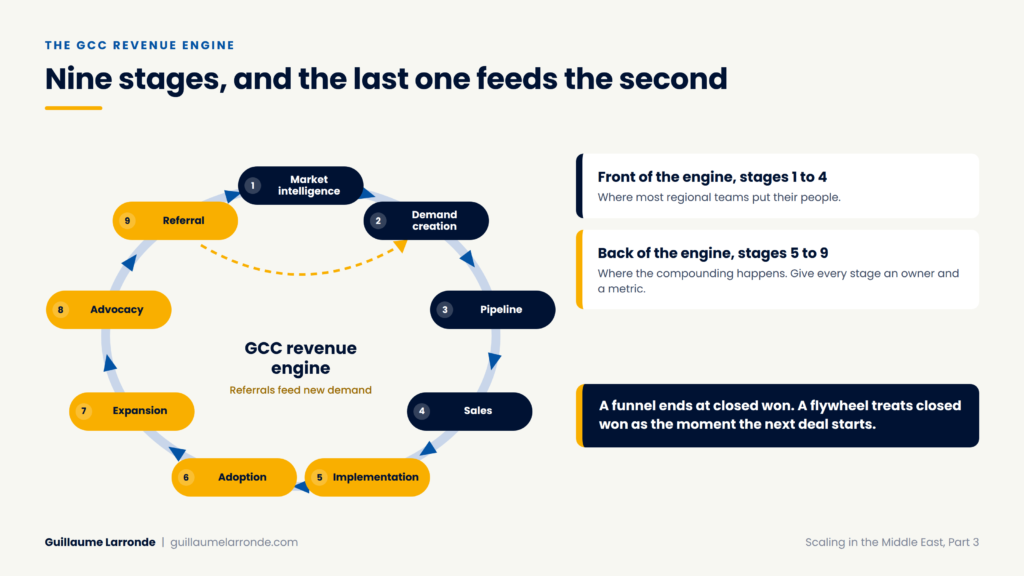
The practical consequence: stages 5 to 9 need owners and metrics just as much as stages 2 to 4. Most regional teams staff the front of the engine and neglect the back. The back is where the compounding happens.
Organise the region for the next stage of growth
From founder-led to leadership-led growth
The founder or executive who opened the region in Part 2 can’t stay the regional sales leader forever. Roles tend to arrive in this order:
| Role | Typical trigger |
|---|---|
| Country manager or regional sales director | More deals than the founder can personally run |
| Solutions engineering in region | Security reviews and demos slowing deals |
| Customer success in region | Enough customers that HQ time zones hurt retention |
| Marketing manager, regional | Events and content need local ownership |
| Partner director | Partners source a meaningful share of pipeline |
| RevOps | Forecast accuracy and data quality start to slip |
| Regional VP | More than one country or more than two teams |
Watch span of control. When I first managed in Dubai, the team was about ten people across four segments. That’s roughly the limit for one first-line manager doing real coaching. Beyond it, add a layer before quality drops, not after.
And a lesson I learned the hard way as a new manager: new managers try to be the best salesperson on the team. The job is the opposite. Make several people better than you were, and accept that it feels like doing less while being more accountable.
Geography, vertical, segment or hybrid
- Geography: UAE team, Saudi team, rest of GCC. Simple, fits nationalisation rules and working weeks.
- Vertical: financial services, government, energy, retail. Deep expertise, but thin coverage across countries.
- Segment: enterprise and mid-market. Matches sales motion to deal size.
- Hybrid: most mature organisations combine two, for example Saudi enterprise, UAE enterprise, and a GCC mid-market team.
Choose the model your data supports. If 70% of revenue is Saudi financial services, the structure should say so.
UAE hub, Saudi hub or dual hub?
In Part 1 you chose a base on assumptions. Now revisit it with operating evidence:
| Evaluate | What the data should tell you |
|---|---|
| Revenue and pipeline | Where the money is today and next year |
| Customers | Where the reference accounts sit |
| Talent | Where you can hire and keep good people |
| Leadership | Where your senior people need to be |
| Costs | Fully loaded cost per seller by country |
| Regulation | Nationalisation, data and licensing requirements |
| Government access | Whether RHQ or in-country presence now matters |
| Travel and partners | Where your partners and executives spend their time |
For multinationals with Saudi government ambitions, the Regional Headquarters programme becomes a real question at this stage. Since January 2024, multinationals doing business with Saudi government entities have been required to base their regional headquarters in the Kingdom, and an RHQ needs at least 15 full-time employees, including senior executives, within its first year. For a startup, it’s worth assessing once government revenue is material, with advisers.
How do you expand to Qatar, Kuwait, Bahrain and Oman?
A good GCC expansion strategy doesn’t repeat the original mistake. The first expansion often starts with a bold claim like “the GCC is our market”. The second one tends to start with a single inbound lead from Doha. Neither is a strategy.
Score each country before committing people. Here’s the country expansion score I’d use, with illustrative weights:
| Factor | Weight | What to measure |
|---|---|---|
| Market opportunity | 15% | Number of SOA accounts, ACV |
| ICP density | 15% | Share of accounts that match ICP A |
| Customer pull | 20% | Existing customers’ subsidiaries, inbound, RFPs |
| Existing pipeline | 15% | Qualified pipeline already there |
| Competition | 10% | Strength of local and global competitors |
| Regulation | 10% | Licensing, data rules, local agent requirements |
| Partners | 10% | Quality of available partners |
| Cost and talent | 5% | Cost to serve and ability to hire |
A few country notes to start the research:
- Qatar: concentrated, government and energy heavy. Fewer, larger accounts, and references from Qatari entities matter.
- Kuwait: strong role for local agents and distributors, conservative buying. Partner-led entry is common.
- Bahrain: smaller market with an open regulatory posture, often a fintech testbed and close to Saudi Arabia’s Eastern Province.
- Oman: government-led diversification. Often served from the UAE, with partners, in early years.
Most startups serve these four markets from a UAE or Saudi hub, through partners and travelling sellers, for a long time. Open a local presence when the score and the pipeline both say so.
RevOps, capacity and compensation turn a team into a machine
Build regional RevOps
This is where companies scaling in the Middle East either become predictable or stay dependent on heroes. RevOps covers:
- CRM architecture: regional fields, currencies, languages, account hierarchies for groups.
- Territories: by country, vertical or segment, with clear account ownership.
- Lead routing: inbound and partner leads to the right owner within hours.
- Stages: buyer-evidence stages from Part 2, enforced.
- Attribution: sourced and influenced pipeline by channel and partner.
- Forecasting: weekly roll-up with accuracy tracked against actuals.
- Dashboards: one version of the truth for region and HQ.
- Compensation operations: accurate, timely commission calculations.
- Data quality: mandatory fields and hygiene reviews.
- Capacity: seller and manager capacity against target.
Adding a tool to an unclear process is putting a faster engine in a car with no steering. You arrive at the wrong place sooner. Fix definitions and process first, then tooling.
Capacity planning, with the actual formulas
This is where regional planning moves from market entry to revenue leadership. Start with the theoretical number of sellers:
Theoretical sellers = revenue target ÷ productive quota per seller.
Then adjust for reality:
- Ramp: a new seller in the region may take six to nine months to reach full productivity. Count them as a fraction until then.
- Attainment: if the team historically hits 80% of quota on average, divide by 0.8.
- Attrition: if you lose one in five sellers a year, hire ahead of it.
- Seasonality: Ramadan and summer reduce selling capacity. Plan quotas by quarter, not evenly.
- Manager capacity: one first-line manager for roughly six to ten sellers.
An illustrative example. A $6M new-ARR target with an $800k productive quota gives 7.5 theoretical sellers. At 80% average attainment, that’s about 9.4. With two of those in ramp at half productivity for most of the year, plan for around 10 or 11 sellers, plus one or two first-line managers. Now the hiring plan is anchored to maths, not hope.
Compensation architecture for a GCC team
- Quotas: set from territory potential and capacity maths, not last year plus 30%.
- Commission: a clear rate on new business, paid on a defined event.
- Accelerators: above-target rates that reward real overperformance.
- New business versus expansion: different rates, so both get attention.
- Partner-sourced deals: credit rules that make sellers work with partners, not around them.
- Multi-year contracts: decide how year two and three are credited.
- Collections: consider paying part of commission on payment, given longer payment cycles.
- Strategic deals: a separate plan for large government or enterprise deals with long cycles.
Good salespeople leave for reasons that show up as compensation and were usually about something else, like unclear territories or broken promises on accounts. Clean rules prevent most of it.
Run partners as a channel, with rules of engagement
From finding partners to operating a partner channel
In year one you found partners. By year three you operate a channel. The lifecycle has nine steps:
- Recruit
- Qualify
- Enable
- Certify
- Co-market
- Co-sell
- Measure
- Tier
- Exit
Tiering and exit are the steps most companies skip. Partners who don’t perform should move down a tier or leave the programme, so your enablement budget goes to partners who produce.
Measure the channel with six numbers:
- Partner-sourced ARR
- Partner-influenced ARR
- Active partners, using the activated partner rate from Part 2
- Partner pipeline
- Partner win rate
- Partner deal velocity
Manage channel conflict before it manages you
As direct sellers, resellers, distributors, integrators and referral partners all touch the same accounts, conflict is guaranteed. Write the rules before the first dispute:
- Account ownership: a named-account list per channel, reviewed quarterly.
- Deal registration: the first to register a qualified deal is protected for a fixed period.
- Margins: published by partner type and tier.
- Territories: clear by country and segment where it matters.
- Rules of engagement: when direct sellers step in, and how partners are credited when they do.
The rule that matters most is consistency. Partners forgive a strict rule. They don’t forgive an exception made for someone else.
Customer success becomes the biggest source of regional revenue
By year three, the most efficient growth in the region usually comes from existing customers: new divisions, new countries, new products and referrals to their peers. Structure customer success around four stages:
- Land: a first contract with clear success criteria.
- Adopt: usage and value proven in the first 90 to 180 days.
- Expand: more users, divisions, countries or products.
- Advocate: references, case studies, events, peer introductions.
Track these metrics monthly:
| Metric | What it tells you |
|---|---|
| Time to value | How fast customers get the promised outcome |
| Adoption | Whether the product became part of the work |
| Gross revenue retention (GRR) | How much revenue you keep, before expansion |
| Net revenue retention (NRR) | Whether existing customers grow |
| Expansion ARR | Revenue added from current customers |
| Churn | Who left, and the real reason why |
| Referenceable customers | How many will take a call for you |
In a Gulf group company, one successful division is often the best route into five others. Map group structures in the CRM and plan expansion by group, not by logo.
Build a regional brand and a content moat competitors can’t copy
From “nobody knows us” to a recognised player
In year one, buyers didn’t know you. By year three, the target is simple: when a GCC buyer builds a shortlist in your category, you’re on it. The levers:
- PR: regional business and tech media, tied to customer wins and data.
- Research: original regional data, covered below.
- Executives: your regional leaders speaking, writing and visible on LinkedIn.
- Events: a signature roundtable or annual event you own.
- Analysts: briefings with the analysts regional buyers read.
- Customers: named GCC customers speaking for you.
- Communities: leadership roles in your industry association or startup hub.
- Point of view: a consistent, specific view on your category’s regional problems.
Proprietary regional data is the moat
Instead of another “five AI trends for next year” article, produce proprietary regional IP. For example:
- A GCC B2B benchmark report for your category
- A Middle East buyer study
- A Saudi industry transformation index
- A UAE SaaS benchmark
- An annual GCC sales report
Regional data is scarce, so it gets used. One report can feed PR, SEO, answer-engine citations, sales conversations, event content and partner co-marketing for a full year. Competitors can copy a feature. They can’t copy three years of your data.
People, enablement and AI decide how fast the engine runs
Build local leadership and national talent
- Hiring: a clear profile per role, with regional experience weighted properly.
- Management: first-line managers promoted or hired for coaching ability, not only selling ability.
- Succession: a named successor for every regional leadership role.
- Enablement: onboarding and development built for the region.
- National talent: Saudi and Emirati hires in customer-facing and leadership roles, with real careers.
- Graduate programmes: a pipeline of junior national talent trained your way.
- Diversity: teams that reflect the buyers they serve.
- Leadership development: a path from seller to manager to regional leader.
Localisation requirements affect organisational design, not only HR compliance. Saudi Arabia’s 60% Saudization requirement for specified sales and marketing professions, effective 19 April 2026, illustrates it directly. At scale, a Saudi commercial team is majority Saudi by rule, so leadership development for national talent is the growth plan, not a side programme.
Sales enablement for a regional team
- Onboarding: a 30, 60 and 90-day plan with regional accounts, partners and procurement paths.
- Playbooks: the regional playbook, used in every deal review.
- Call libraries: recorded regional discovery calls and demos, with permission.
- Certification: sellers certified on discovery, demo and qualification before they run deals alone.
- Coaching: weekly, diagnostic, focused on activity, skill or belief, whichever is actually the problem.
- Battlecards: by competitor type and country.
- Product training: including the regional features and hosting options.
- Industry training: how a Saudi bank or a UAE government entity actually works.
- AI coaching: call analysis and practice scenarios, reviewed by managers.
When a rep works hard and still misses, separate the three causes first: activity, skill or belief. Each has a different fix, and the wrong one makes it worse.
AI as the revenue operating layer
Don’t create an “AI department”. Use AI horizontally, across the engine:
| Stage | Where AI helps | What stays human |
|---|---|---|
| Market intelligence | Monitoring triggers, tenders, leadership changes | Deciding which signals matter |
| Account research | Account briefs before every meeting | The point of view you bring |
| Prospecting | Research-led personalisation | The relationship and the introduction |
| Meeting prep | Stakeholder summaries, question lists | Reading the room |
| Call intelligence | Notes, action items, deal risk flags | Judgement on the deal |
| CRM | Data entry, hygiene, next-step reminders | Honest stage decisions |
| Forecasting | Pattern analysis across deals | The commit call |
| Coaching | Call analysis, practice scenarios | The manager’s diagnosis |
| Content | First drafts, localisation support | The argument and the stories |
| Proposals and RFPs | First drafts from approved content | Pricing and commitments |
| Customer success | Usage alerts, health scores | The executive relationship |
| Partner intelligence | Partner pipeline and activity analysis | Partner strategy |
AI did to commercial work what the calculator did to accounting. The arithmetic got free. The judgement got more valuable. In my own work building AI content systems in production, the lesson was the same: the tool was never the constraint. The constraint was the raw material and the standard. An AI layer on top of a messy CRM and no playbook produces fluent nonsense faster.
Run the region as a P&L, with clear decision rights
Manage the regional P&L
At this stage the executive question changes. It moves from “how much Middle East revenue do we have?” to “are we building an economically sustainable regional business?”. To answer it, the regional leader needs to own and understand:
| Line | What to watch |
|---|---|
| Revenue and ARR | Growth, mix by country and segment |
| Gross margin and COGS | Hosting, implementation and support costs by region |
| OPEX and headcount | Fully loaded cost per role and country |
| CAC and marketing spend | Cost to acquire, by channel |
| Contribution margin | What the region contributes after its direct costs |
| EBITDA | Whether the region stands on its own |
| Working capital and cash | The effect of payment terms and collections |
| DSO | Days sales outstanding, often longer with government customers |
Watch DSO closely. A region can look profitable on paper and consume cash for months because of payment cycles. Your CFO should see collections by customer type every month.
The HQ and region decision rights matrix
Unclear decision rights are one of the quietest ways to kill a regional business. Every decision sent back to HQ adds weeks, and Gulf buyers notice. Write the matrix down:
| Decision | HQ owns | Region owns | Shared |
|---|---|---|---|
| Hiring below director level | ✓ | ||
| Director and above hiring | ✓ | ||
| Pricing and price books | ✓ | ||
| Discounts within approved bands | ✓ | ||
| Product roadmap | ✓ | ||
| Regional product priorities | ✓ | ||
| Partner selection | ✓ | ||
| Partner programme terms | ✓ | ||
| Regional marketing plan and budget | ✓ | ||
| Brand guidelines | ✓ | ||
| Annual budget | ✓ | ||
| Legal exceptions in contracts | ✓ |
The specific split will differ by company. What matters is that it exists, it’s written down, and the regional leader can decide quickly within it.
Product localisation at scale follows customer evidence
In Part 1 localisation was based on assumptions. Now you have customer data. Prioritise from it:
- Arabic: interface, content, support, where users actually need it.
- Hosting: in-country hosting where customers or rules require it. AWS says its first Saudi region is on track for December 2026.
- Integrations: with the regional systems your customers actually run.
- Reporting: regional formats and regulatory reports.
- Payments: local payment methods and currencies.
- Compliance: sector certifications that keep coming up in security reviews.
- Support: hours and language that match the region’s working weeks.
- Industry functionality: features specific to the regional verticals you win in.
Don’t localise based on anecdotes. Count how many deals each gap blocked or slowed, and multiply by ACV. That’s the business case.
When regional GTM becomes corporate strategy
Partnerships, joint ventures and M&A
As the region becomes a larger share of the business, the options widen:
- Acquisitions: buying a regional player for customers, team or licences.
- Joint ventures: a local partner for government-heavy or regulated sectors.
- Investments: regional investors who bring access as well as capital.
- Strategic alliances: deep partnerships with a regional telco, bank or integrator.
- Government programmes: national technology and localisation programmes.
- Sovereign-backed initiatives: programmes linked to national investment funds and their portfolio companies.
At this point GTM starts becoming corporate strategy. The regional leader should be in the room when these decisions are made.
Risk management and resilience
A regional business needs a risk register reviewed every quarter:
| Risk | Example | Mitigation |
|---|---|---|
| Regional events | Travel disruption, event cancellations | Distributed team, remote-ready processes |
| Regulatory change | New nationalisation or data rules | Adviser reviews, early compliance |
| Economic exposure | Budget cycles tied to energy prices | Sector diversification |
| Customer concentration | Two customers are half of revenue | Pipeline across more accounts |
| Partner dependency | One partner sources most deals | Second partner per segment, direct capability |
| Currency | USD-pegged versus other currencies in your model | Pricing and billing currency choices |
| Cybersecurity | Regional customer data exposure | Security programme, certifications |
| Talent | Key person leaves | Succession plans, documented relationships |
| Payments | Slow collections | Payment terms, collections process |
| Government dependency | Budget shifts in public spending | Private-sector pipeline balance |
Then build three scenarios for the next 24 months: base, upside and downside. Decide in advance what you’d do in the downside case, so it’s a plan rather than a panic.
The three-year financial architecture
These three stages are organisational illustrations, not universal benchmarks. Use them to test whether your org shape matches your revenue.
| Stage | Regional ARR | Leadership | Commercial team | Support functions |
|---|---|---|---|---|
| Beachhead | $1M to $3M | Founder or executive sponsor, one regional lead | Two to five sellers, one partner lead or founder-owned | Shared SE, CS and marketing from HQ |
| Regional business | $5M to $15M | Regional VP or GM, country managers | Two or more sales teams by country or segment, partner manager | Regional SE, CS team, marketing manager, RevOps |
| Strategic region | $20M and above | Regional GM with P&L, leadership team | Multiple teams, channel organisation | Full regional functions, local product input, finance |
The Middle East GTM maturity model and the 36-month roadmap
The seven levels of Middle East GTM maturity
This is the framework that ties the whole series together. Use it to place your company honestly, then plan the next level, not the last one.
| Level | Name | What it looks like |
|---|---|---|
| 0 | Opportunistic | Random Middle East revenue, no plan, no owner |
| 1 | Exploring | Research, discovery calls, remote or fly-in selling |
| 2 | Beachhead | Local presence, often a startup hub, first customers |
| 3 | Repeatable | Validated ICP, predictable wins, first references |
| 4 | Systemised | Playbook, RevOps, active partners, customer success |
| 5 | Regional engine | Predictable growth across more than one country |
| 6 | Strategic region | Regional leadership, P&L, partner network, influence on product |
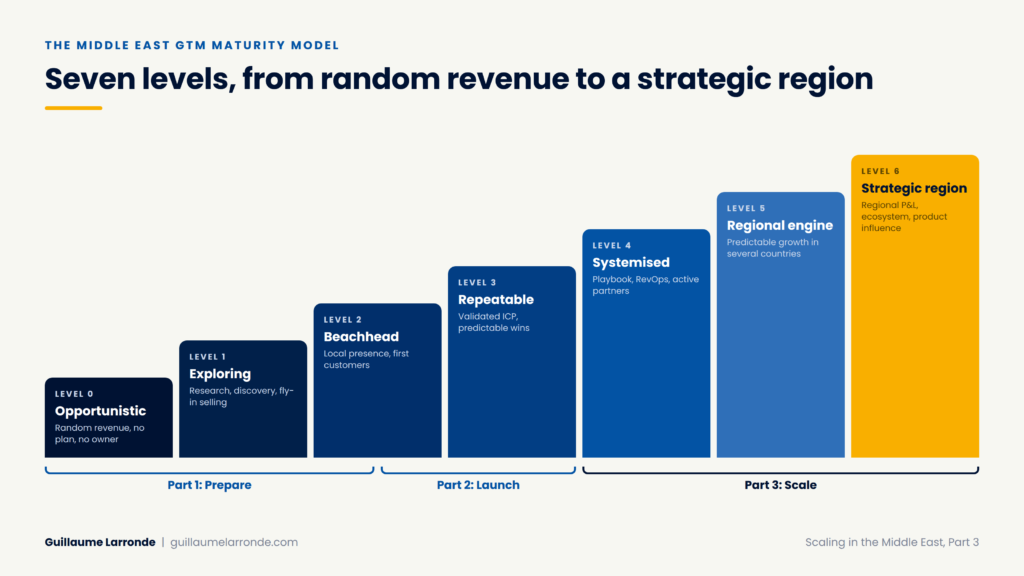
Part 1 takes you from level 0 to the edge of level 2. Part 2 takes you from level 2 to level 3. This article covers levels 4 to 6.
The 36-month roadmap, closed
Here’s the same table that opened the series, now with every phase behind you or in front of you.
| Phase | Timing | Objective | Critical question |
|---|---|---|---|
| Discover | T-12 to T-6 | Validate | Is there really a market for us? |
| Design | T-6 to launch | Prepare | How should we enter? |
| Launch | Months 0 to 3 | Establish | Can we operate? |
| Validate | Months 3 to 6 | Sell | Will customers buy? |
| Prove | Months 6 to 12 | Repeat | Can we win repeatedly? |
| Systemise | Year 2 | Operationalise | Can others reproduce it? |
| Expand | Years 2 to 3 | Extend | Where else does it work? |
| Scale | Year 3 and beyond | Optimise | Can we build a profitable regional engine? |
Every phase answers one question with evidence before the next phase spends money. That’s the whole method.
Frequently asked questions about scaling in the Middle East
When should a startup hire a country manager in the GCC?
When there are more qualified deals than the founder or first regional lead can personally run, and the motion is repeatable enough to hand over. Hire a builder who can run a P&L, give them budget, a team and decision rights, and keep the founder involved in the top strategic accounts for a transition period.
Should a scaling company base its regional team in the UAE or Saudi Arabia?
Decide from operating evidence: where revenue, pipeline, reference customers, talent and government access sit. Many companies keep a UAE regional hub and build a strong Saudi operation, or move to a dual hub. Saudi government ambitions may eventually raise the Regional Headquarters question.
How do you expand from the UAE and Saudi Arabia to the rest of the GCC?
Score each country on market opportunity, ICP density, customer pull, existing pipeline, competition, regulation, partners and cost. Serve Qatar, Kuwait, Bahrain and Oman from your hub through partners and travelling sellers first, and open local presence only when the score and qualified pipeline both justify it.
What metrics show a Middle East business is scaling well?
Look beyond ARR. Track net and gross revenue retention, win rate and sales cycle by country, forecast accuracy, partner-sourced ARR, activated partner rate, CAC payback, DSO and the number of referenceable customers. Improving retention and references alongside growth shows the flywheel is turning.
How should AI be used in a regional revenue team?
As a horizontal layer across the engine: account research, meeting prep, call notes, CRM hygiene, forecasting analysis, coaching and first drafts. Keep judgement human: deal strategy, relationships, pricing and commitments. AI on top of unclear process and poor CRM data only produces wrong answers faster.
Scaling in the Middle East is done when the regional business no longer depends on the people who started it. Everything in year two and three is about making that true without losing the relationships that got you there.
This article is part of a 3 article series. If you’re earlier in the path, start with Part 1: Entering the Middle East or Part 2: Launching in the Middle East.