
A Middle East go-to-market strategy starts with evidence, and the office comes last. Before you hire in Dubai or Riyadh, prove three things: which accounts in which GCC country actually need you, how those accounts buy, and whether you can fund 24 to 36 months of building. The licence, the first hire and the launch all follow from those answers.
I moved to Dubai in 2012 as one of three people on LinkedIn’s Middle East founding team. No local brand recognition in enterprise, no regional playbook, and a buying culture the headquarters motion simply didn’t account for. I’ve been building commercial engines in the region since. This guide is what I’d want a founder or CRO in London, Berlin, Austin, Singapore or Sydney to read before they sign a lease.
This is Part 1 of a three-part series. Part 1, this article, covers the 6 to 12 months before launch. Part 2: Launching in the Middle East covers the first 12 months on the ground. Part 3: Scaling in the Middle East covers years two and three, when you turn early wins into a repeatable GCC revenue engine.
The series runs on one idea: prepare, prove, systemise, scale. And one rule.
Don’t scale presence before you’ve scaled evidence.
In this article
- The Middle East is six markets, and the opportunity is real enough to punish vague plans
- The 36-month path from first research to a regional revenue engine
- Why are you entering the Middle East, and are you actually ready?
- Pick your first market by ICP density, not by the map
- Size the opportunity in accounts, then learn how those accounts buy
- Validate on the ground before you commit capital
- Choose the entry model and the startup hub you land in
- Localise, price and partner before you launch
- Build the first team as a pod, and plan for nationalisation from day one
- Build the business case, then pass the go/no-go gates
Key takeaways
- The GCC is six countries with different buyers, rules and cycles. “The Middle East” is not a market.
- Enter on pull signals (customers, inbound, RFPs), not on board pressure or a Dubai visit.
- Size the opportunity in named, obtainable accounts, not TAM. Forty real accounts beat a $5bn slide.
- Land in a startup hub first. A couple of desks in AstroLabs, in5 or DIFC buy you speed and a network.
- Design your first year as a flywheel: the first customers are there to create the next ones.
The Middle East is six markets, and the opportunity is real enough to punish vague plans
The money is real. Gartner forecast MENA IT spending at $169 billion for 2026, up 8.9% on 2025, with software spending growing 13.9% to about $20.4 billion. Governments are funding diversification programmes. Banks, energy companies, airlines, retailers and ministries are buying AI, cloud, cybersecurity and automation at the same time.
That’s exactly why vague plans fail here. When a market is growing and visible, everyone arrives. The companies that win are the ones who knew which door to knock on.
So start with the geography, because it’s where most plans go wrong first.
- MENA is not the GCC: MENA includes Egypt, Morocco, Jordan and others, with very different price points and buying power.
- The GCC is six countries: the UAE, Saudi Arabia, Qatar, Kuwait, Bahrain and Oman.
- Each country is its own market: different regulators, procurement habits, working weeks and decision speeds.
- Each country splits by sector: a Saudi bank and a Saudi retailer buy software in completely different ways.
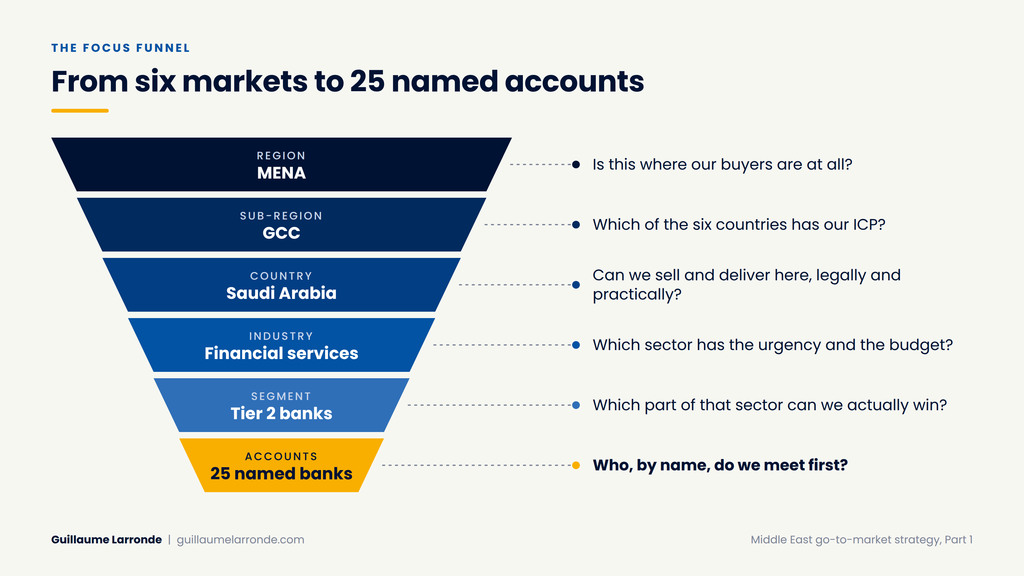
The right way to think about it is a funnel of focus. You narrow from region to country, then to industry, segment and finally named accounts. Each step removes noise.
The 36-month path from first research to a regional revenue engine
Most founders think about Middle East expansion as a launch date. It’s better to think about it as a 36-month programme with eight phases, each with one question it must answer before the next one starts. This series follows that path. Part 1 covers the first two phases.
| Phase | Timing | Objective | Critical question |
|---|---|---|---|
| Discover | T-12 to T-6 | Validate | Is there really a market for us? |
| Design | T-6 to launch | Prepare | How should we enter? |
| Launch | Months 0 to 3 | Establish | Can we operate? |
| Validate | Months 3 to 6 | Sell | Will customers buy? |
| Prove | Months 6 to 12 | Repeat | Can we win repeatedly? |
| Systemise | Year 2 | Operationalise | Can others reproduce it? |
| Expand | Years 2 to 3 | Extend | Where else does it work? |
| Scale | Year 3 and beyond | Optimise | Can we build a profitable regional engine? |
Launch, validate and prove are covered in Part 2. Systemise, expand and scale are covered in Part 3.
One idea runs through all eight phases: the flywheel. In the Gulf, enterprise communities are small and references travel fast. A well-chosen first customer gives you a reference, the reference opens the next meeting, the next meeting brings a partner, and the partner brings two more customers. Every preparation decision in this article should make that first turn of the flywheel more likely.
Why are you entering the Middle East, and are you actually ready?
Start with why, before TAM. The reason you’re entering decides how much patience you’ll have, and patience is the resource most expansions run out of first.
Pull signals are evidence, push signals are pressure
Pull signals mean the market is already asking for you:
- Existing customers in the region, even small ones
- Inbound leads or trial sign-ups from GCC domains
- RFP invitations you didn’t chase
- Global customers asking for local support or local invoicing
- Partner enquiries from integrators or resellers
- Multinational clients with GCC operations already using you elsewhere
Push signals mean someone at home wants you to go:
- Board or investor expectations
- A competitor announcing a Dubai office
- A slowing home market
- A large TAM figure in a consultancy report
- The CEO visited Dubai for three days and saw opportunity everywhere
That last one is more common than anyone admits. Dubai is very good at looking like opportunity from a hotel lobby.
Push signals aren’t wrong. They’re just not evidence. If all your reasons are on the push list, your first job is to create pull before you create presence.
Market interest isn’t market validation.
The Middle East GTM readiness score
Score your company honestly on eight dimensions, 1 to 5 each, 40 maximum. There’s no magic threshold. The point is to expose the weak dimension before the market does.
| Dimension | The question | What a 5 looks like |
|---|---|---|
| Product | Does the product travel? | Works without heavy customisation, integrations exist or are easy |
| Product-market fit | Is the home business repeatable? | Predictable wins in a defined ICP at home |
| Market | Is GCC demand demonstrated? | Paying customers or qualified pipeline in the region |
| Financial | Can you fund 24 to 36 months? | Budget ring-fenced, not borrowed from next quarter |
| Leadership | Will executives commit time? | A named executive sponsor who travels to the region |
| Operations | Can you support another region? | Support, legal and finance can absorb new time zones and contracts |
| Localisation | What needs adapting? | Known list, costed, prioritised |
| Talent | Who will build the market? | A named builder, not “we’ll hire someone” |
Two scores matter more than the total. A 1 or 2 on financial means you’ll pull out in month 10, right before the first deals land. A 1 or 2 on leadership means the region becomes one person’s problem, and that person usually leaves.
From experience, the failure points repeat across companies. I spent seven years inside more than 20 commercial engines across Europe and the Middle East, and it was almost always the same four: unclear positioning, undefined process, misaligned incentives, and a leader measuring effort instead of outcomes. The readiness score is built to surface those four before you’ve spent anything.
Pick your first market by ICP density, not by the map
What “Middle East” should mean for your company
Each GCC country deserves its own one-paragraph case in your plan.
- UAE: the regional hub. Fast setup, deep expat talent pool, strong free zones, and most regional headquarters of multinationals. Dubai for commerce, Abu Dhabi for government, sovereign capital and energy.
- Saudi Arabia: the largest economy and the largest enterprise and government buyer base in the GCC. More setup work, more localisation, bigger contracts.
- Qatar: concentrated, wealthy, government and energy heavy. Fewer, larger accounts.
- Kuwait: conservative buyers, strong relationships with local agents and distributors, slower decisions.
- Bahrain: smaller market, open regulation, often a testbed for fintech and a gateway to Saudi’s Eastern Province.
- Oman: smaller, government-led diversification, often served from the UAE in early years.
Then ignore the map. Geography should follow ICP density. A SaaS company selling to airlines has a completely different regional map from one selling to banks or oil and gas operators. Draw your map from where your buyers are concentrated, not from where the flights go.
UAE or Saudi Arabia first? The honest comparison
This is the biggest decision in Part 1, so it gets the biggest table.
| Factor | UAE | Saudi Arabia |
|---|---|---|
| Market size | Smaller, high density of regional HQs | Largest GCC economy, largest buyer base |
| Enterprise density | High, especially regional offices of global firms | High and growing, many large domestic champions |
| Government opportunity | Significant, federal and emirate level | Very large, but access favours in-Kingdom presence |
| Ease of setup | Fast, many free zones and startup licences | More steps, MISA licence and local registrations |
| Talent | Deep multinational expat pool | Growing national talent, nationalisation quotas apply |
| Operating cost | High in prime Dubai locations | Varies, Riyadh prime space is not cheap either |
| Regulation for foreign owners | 100% foreign ownership allowed for most mainland activities | 100% foreign ownership possible in many sectors via MISA |
| Procurement | Varies by entity, generally faster | Formal, government portal-based for public entities |
| Regional connectivity | Global aviation hub | Well connected, especially Riyadh and Jeddah |
| Working week | Monday to Friday | Sunday to Thursday |
| Customer expectation | Comfortable buying from regional offices | Increasingly expects in-Kingdom presence and people |
A few facts behind that table, because they’re the ones founders get wrong.
On UAE ownership, the country has allowed 100% foreign ownership of mainland companies since 1 June 2021, with restrictions kept for strategic activities such as security, banking and communications. Free zones have long allowed full foreign ownership, but a free zone licence doesn’t automatically let you trade with mainland customers the way a mainland licence does. Check what your licence lets you invoice before you pick it.
On Saudi government access, the Regional Headquarters programme matters. Since 1 January 2024, multinationals doing business with Saudi government entities have been required to base their regional headquarters in the Kingdom, and an RHQ needs at least 15 full-time employees within its first year.
In 2026 the Kingdom formalised exemptions to the rule, and government purchases below SAR 1 million sit outside it. For most startups, an RHQ is years away. That’s fine. Early Saudi government deals usually come in under that threshold or run through a local partner.
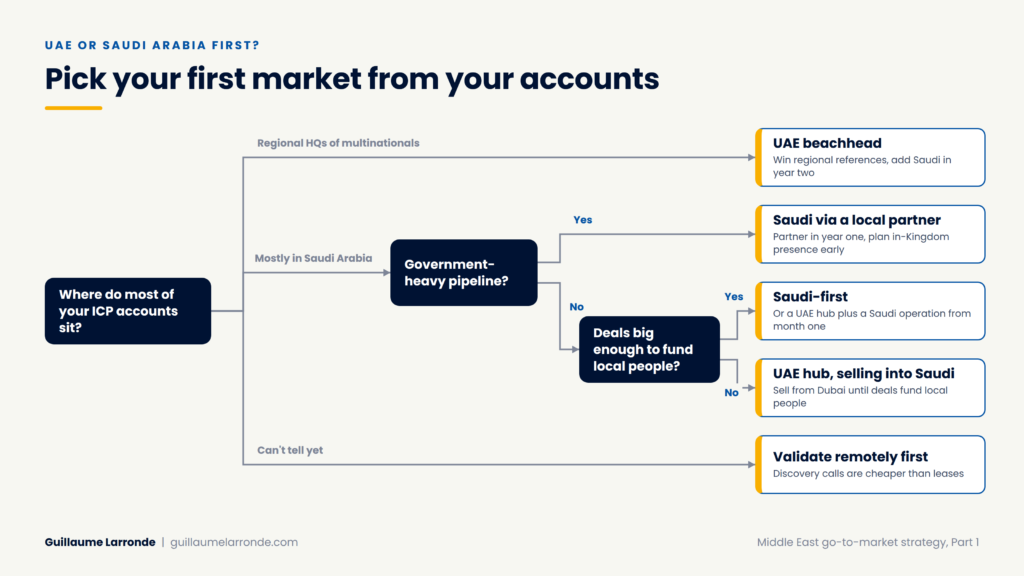
My decision tree is short:
- If more than half your ICP accounts are in Saudi Arabia and your deals are large enough to fund local people, go Saudi-first or run a UAE hub with a Saudi operation from month one.
- If your buyers are regional HQs of multinationals, start in the UAE.
- If your ICP is government-heavy in Saudi, budget for a local partner in year one and plan your in-Kingdom presence early.
- If you can’t tell yet, validate remotely before you choose. Discovery calls are cheaper than leases.
Five entry patterns that actually work
- A. UAE beachhead, then GCC: land in Dubai or Abu Dhabi, win regional references, expand to Saudi in year two.
- B. Saudi-first: go straight to Riyadh when the ICP and deal sizes are overwhelmingly Saudi.
- C. UAE regional hub plus Saudi operation: leadership and support in Dubai, sellers and delivery in Riyadh.
- D. Remote validation, then partner, then local presence: sell from home, sign a partner, open only once the partner proves demand.
- E. Follow existing customers: serve your global accounts’ GCC subsidiaries first and use them as references.
Pattern E is the most underrated. It turns the flywheel before you’ve even landed, because your first regional reference is a customer you already have.
Size the opportunity in accounts, then learn how those accounts buy
Serviceable obtainable accounts beat a $5bn TAM slide
TAM, SAM and SOM are fine for a board deck. For enterprise B2B in the Gulf, I’d add a fourth number: serviceable obtainable accounts, or SOA. It’s the count of named accounts you can realistically reach, sell to and serve in the first 24 months.
Here’s an illustrative example for a company selling to banks:
- 250 banks and financial institutions across the GCC
- 80 match the ICP on size, technology and use case
- 45 are realistically addressable in year one and two
- 25 are likely buyers based on triggers and budget cycles
- At an illustrative $150k ACV, that’s the real opportunity to plan against
Now management has a number it can manage: 25 accounts, not $5 billion.
Segment the list on the dimensions that change how you sell:
- Country and vertical
- Revenue and employee count
- Ownership: family, government-linked, listed, multinational subsidiary
- Technology maturity and existing vendors
- Use case and likely ACV
- Procurement accessibility: can you even get registered as a vendor?
Your home ICP probably needs rebuilding
Your European or American ICP might travel. Probably only in part. Test it against the attributes that behave differently here:
- Firmographics: the same revenue band can mean a very different buyer.
- Technographics: some sectors run global stacks, others run heavily customised local systems.
- Transformation maturity: a Vision 2030 programme can create urgency you’d never see at home.
- Regulatory exposure: data residency and sector rules can disqualify a perfect-fit account.
- Ownership and government involvement: a government-linked company buys like a ministry, not like a scale-up.
- Budget and urgency: budget cycles, and who controls them, change the timing.
Then build three ICPs, not one. ICP A is your primary bet. ICP B is a secondary segment you’ll pursue opportunistically. ICP C is an experiment with a budget and an end date.
How Gulf organisations buy, and why “yes” isn’t a commercial yes
This deserves real time, because it’s where Western playbooks break. When I arrived in Dubai in 2012, the region required a different sequence from the one headquarters had trained us on: relationship first, use case second, procurement third. It still does.
Map every account against the full cast:
- User and champion
- Business sponsor
- Technical buyer, IT and cybersecurity
- Data and privacy
- Procurement, legal and finance
- Economic buyer
- Regional management and, often, global HQ
A warm “yes” from your contact in a Gulf enterprise often means “I like you and I’ll try”. It isn’t a commercial yes until the approval chain has moved.
The chain usually looks like this:
- Need
- Champion
- Authority
- Technical approval
- Commercial approval
- Procurement
- Contract
- Purchase order
- Payment
Each step can take weeks. Part 2 maps this hidden sales cycle in detail, including vendor registration and government tenders.
Validate on the ground before you commit capital
Thirty to fifty discovery conversations, structured
I’d treat 30 to 50 structured conversations as a practical target for a serious validation programme. That’s a working number, not a law. Spread them across:
- Existing customers with regional operations
- Target prospects in ICP A
- Potential partners, integrators and consultancies
- Former customers and lost deals, if you have any in the region
- Industry experts and potential hires
Each conversation should test the same things, so you can compare answers:
- Is the problem real here, and how urgent is it?
- What do they use today, and what does it cost them?
- Who owns the budget, and when is it set?
- How would they buy: process, security review, procurement, contract?
- What would need to be local: language, hosting, support, invoicing?
- Who else are they talking to?
- Would they buy in the next 12 months, and what would stop them?
One practical point. In the Gulf, many of these conversations won’t happen on video with a stranger. They happen in person, often after an introduction. So validation usually means a founder on a plane two or three times before launch. Budget for it.
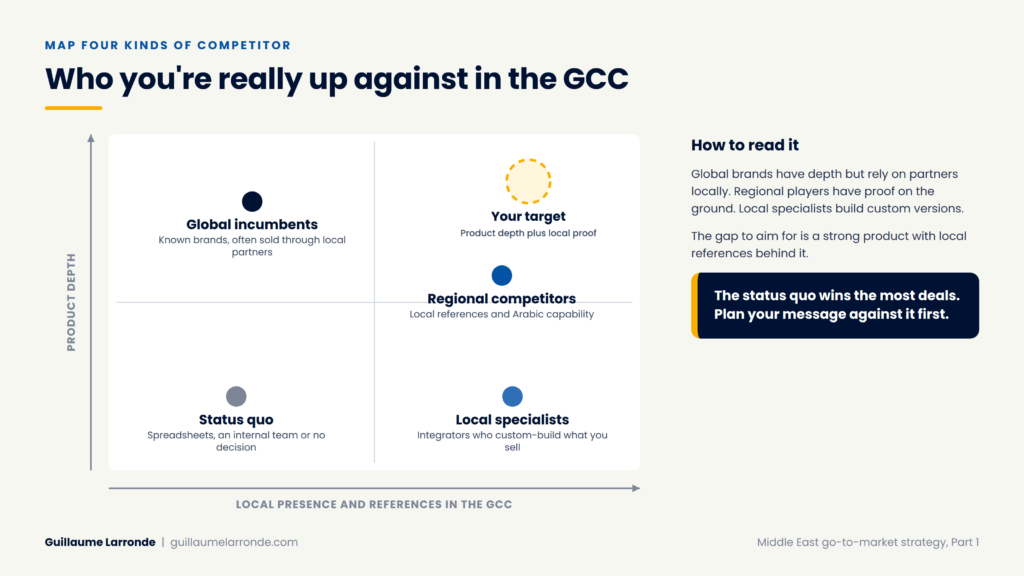
Map four kinds of competitor, including doing nothing
- Global incumbents: the brands your buyers already know, often sold through local partners.
- Regional competitors: companies built in the GCC or wider MENA, with local references and Arabic capability.
- Local specialists: integrators and consultancies that build a custom version of what you sell.
- Status quo: spreadsheets, an internal team, or simply no decision.
For each, capture customers, pricing, positioning, headcount, partners, references, regional offices, Arabic capability, events they sponsor and implementation model. The status quo usually wins the most deals. Plan your message against it first.
Choose the entry model and the startup hub you land in
The entry models, compared on what they cost you and what they teach you
You have more options than “open an office”. Compare each on speed, cost, control and credibility, then think about risk and scalability.
| Model | Speed | Cost | Control | Credibility |
|---|---|---|---|---|
| Remote selling from HQ | Fast | Low | High | Low |
| Fly-in, fly-out founder | Fast | Low to medium | High | Medium |
| Employer of record (EOR) hire | Fast | Medium | Medium | Medium |
| First local employee on your own licence | Medium | Medium | High | Medium to high |
| Startup hub desk plus free zone licence | Fast | Low to medium | High | Medium to high |
| Representative office | Medium | Medium | Medium | Medium |
| Mainland entity | Slower | Higher | High | High |
| Commercial agent | Fast | Low upfront | Low | Depends on agent |
| Distributor or reseller | Medium | Margin-based | Low | Depends on partner |
| Systems integrator | Medium | Margin-based | Low to medium | High in enterprise |
| Joint venture | Slow | High | Shared | High |
| Subsidiary | Slow | High | High | High |
| Regional HQ | Slowest | Highest | High | Highest |
Risk and scalability follow a simple pattern. The cheaper and faster the model, the less you learn about your own ability to sell. Partners give you reach but hide the customer from you. My bias for a startup: one founder or builder on the ground, a startup hub licence, and one partner hypothesis, then graduate as evidence arrives.
Land inside a startup hub: AstroLabs, in5, DIFC, Hub71 and The Garage
This is the most practical advice in the article. Don’t sign a lease in month one. Take a couple of desks inside a startup hub, get your licence and visas through them, and use the community while you find your own office.
A hub gives you four things a serviced office doesn’t: a licence and visa route bundled with the desk, a room full of founders who’ve already solved your next problem, investors and corporates who walk through regularly, and events that put you in front of buyers in your first month.
| Hub | Where | What it’s good for |
|---|---|---|
| AstroLabs | Dubai (JLT, DMCC) and Riyadh (Al Malqa) | Market entry for UAE and Saudi from one provider, licensing, Saudization-ready setups |
| in5 Tech | Dubai Internet City | Early-stage tech startups, subsidised licence during incubation |
| DIFC Innovation Hub and Dubai AI Campus | DIFC, Dubai | Fintech, AI and startups selling to banks, with Innovation and AI licences |
| Hub71 | Abu Dhabi (ADGM) | Startups willing to relocate a founder, selling to Abu Dhabi government and sovereign-linked buyers |
| The Garage | Riyadh (KACST) | Tech startups building a Saudi presence inside a large national startup campus |
A few specifics worth knowing, all from the providers’ own pages:
- AstroLabs runs a coworking hub in Jumeirah Lake Towers in Dubai and a flagship Saudi workspace in Al Malqa, Riyadh. The Dubai-plus-Riyadh setup makes it a natural bridge for pattern C.
- in5 gives incubated startups a licence at AED 1,000 a year and a coworking desk from AED 15,000 in year one. The full licence price of AED 15,000 a year applies after incubation of up to three years.
- DIFC offers an AI Licence subsidised at USD 1,500 a year, including access to coworking space and discounted visas, plus a broader Innovation Licence for tech firms. For fintechs that need to test regulated products, it’s the natural home.
- Hub71 gives accepted startups AED 250,000 in flexible incentives and AED 250,000 in cash for equity through a SAFE note, and expects at least one founder to relocate long term. The next cohort’s deadline is February 2027, for a September 2027 start.
- The Garage in Riyadh covers 28,000 square metres and can host more than 300 startups.
Two cautions. A desk is a base, not a market. The hub gets you into the room; the method gets you the deal. And check what your licence lets you do. Some free zone licences restrict direct trade with mainland customers, which matters if your buyers are onshore.
The flywheel starts here too. Your first introductions often come from the founder at the next desk who sold to your target bank last year.
Setup, tax and data are decisions to make with advisers
This section is deliberately short. It isn’t legal or tax advice, and you shouldn’t take it from a blog. It’s the list of decisions you need to put in front of qualified advisers early, with the official sources to start from. Laws here change often, so date-stamp every assumption in your plan.
Corporate setup, UAE: mainland or free zone, licensed activities, ownership, visas, office requirements, bank account and UBO filings.
Corporate setup, Saudi Arabia: MISA investment licence, commercial registration, municipal licences, employment files, banking, and whether an RHQ will ever matter to you.
Tax and finance: corporate tax, VAT, withholding tax, transfer pricing, permanent establishment risk, intercompany billing, currency, payment terms and e-invoicing.
Two facts to anchor the conversation:
- The UAE’s Federal Tax Authority states that a Qualifying Free Zone Person pays 0% on qualifying income and 9% on other income, and does not get the 0% band on the first AED 375,000 that ordinary taxpayers get. “Free zone means zero tax” is not a plan.
- The UAE’s e-invoicing mandate goes live for businesses under AED 50 million in revenue on 1 July 2027, with an accredited service provider appointed by 31 March 2027. Saudi Arabia already runs mandatory e-invoicing through its tax authority, ZATCA. Your billing stack needs to be ready.
Data, cybersecurity and sector rules: data privacy, cross-border transfers, residency, cloud hosting, cybersecurity, AI rules and anything specific to banking, health or government. Saudi Arabia’s Personal Data Protection Law became fully enforceable on 14 September 2024 and applies to entities outside the Kingdom that process the data of people in it. The UAE has its own federal data law, and DIFC and ADGM run separate regimes.
Hosting is getting easier. AWS says its first Saudi region is on track for December 2026, adding to its existing Middle East infrastructure in Bahrain and the UAE.
The one question to answer before launch: can we legally and practically deliver our product exactly as it runs today? If the answer is no, you have a product decision to make before any sales one.
Questions to take to your tax adviser before launch:
- Which entity invoices which customer, and where does profit land?
- Do our sales activities create a permanent establishment anywhere?
- Do we qualify for any free zone regime, and what would break it?
- What transfer pricing documentation do we need from day one?
- How do VAT and e-invoicing apply to our billing model?
Localise, price and partner before you launch
The five layers of localisation
Localisation doesn’t necessarily mean Arabic translation. It means removing friction from regional adoption. Think in five layers:
| Layer | What it covers | Typical first move |
|---|---|---|
| Product | Arabic interface, right-to-left support, local integrations, hosting | Arabic where end users need it, local hosting where rules require it |
| Commercial | Pricing, currency, contract terms, payment terms | AED and SAR pricing, local contract templates |
| Marketing | Language, examples, case studies, content | Regional examples and one Arabic landing page |
| Operational | Support hours, working week, implementation capacity | Support coverage for Sunday to Thursday and Monday to Friday |
| Cultural | Communication style, meeting norms, buyer expectations | Coaching the team, in-person time budgeted |
The working-week layer catches people. The UAE works Monday to Friday, Saudi Arabia Sunday to Thursday, so a regional team has four shared days. Ramadan changes working hours and decision speed; the 2027 Ramadan is expected to start in early February, depending on the moon sighting. Summer slows many buying decisions. Plan your calendar around all three.
There’s an analogy I use for teams that skip this. Scaling down a headquarters playbook and calling it localisation is like translating a book with a dictionary. Every word technically correct, and nobody wants to read it.
Regional pricing without reflexive discounting
Many companies arrive with a discount, assuming the region expects one. It’s a mistake. It signals a lower-tier offer and anchors every future negotiation.
Decide these before launch:
- Global pricing or regional price books
- Currency: USD, AED, SAR, and who carries FX risk
- How tax is presented on quotes
- Implementation fees, priced separately and honestly
- Partner margins, built in from the start rather than taken from your price later
- Multi-year agreements and what you’ll trade for them
- Payment terms, milestone billing and the working capital they imply
Negotiation will happen. Build room for it into structure and term, not into the list price.
A partner taxonomy and a partner scoring model
“We’ll find a partner” isn’t a strategy. Know what each type actually does:
- Introducer: opens doors, paid per introduction or success fee.
- Referral partner: recommends you, paid a referral fee on closed deals.
- Reseller: buys and resells your product, owns the customer contract.
- Distributor: manages resellers, credit and logistics across a territory.
- Systems integrator: implements you inside a larger programme.
- Consultancy: shapes the buyer’s strategy, and therefore the shortlist.
- Technology alliance: a platform you integrate with and co-sell alongside.
- Implementation partner: delivers onboarding and services you can’t staff yet.
Score candidates on eight criteria, 1 to 5 each: customer access, reputation, technical capability, sales capability, sector expertise, geographic coverage, commitment, and conflict with your other channels. Commitment is the one to test hardest. Ask what they’ll invest, not what they’ll sign.
Build the first team as a pod, and plan for nationalisation from day one
Who should be employee number one?
The usual candidates are a country manager, a sales director, an enterprise AE, a business development lead or a partner lead. The right answer depends on your entry pattern, but the principle doesn’t change: hire a builder, not an operator. An operator improves a system that exists. There’s no system yet.
I think of the difference as an architect and a facilities manager. Both essential, completely different jobs. Ask the facilities manager to design the building and you get a well-maintained structure nobody wants to work in.
And don’t hire one person and give them the whole region with no budget, no team and no decision rights. That’s a rented business card, not a market entry.
Think instead in terms of what I call the GCC beachhead pod:
| Role | Where they sit in year one | What they own |
|---|---|---|
| Commercial lead | In the region | Accounts, partners, first customers |
| Executive sponsor | HQ, travelling monthly | Strategic accounts, budget, decisions |
| Solutions engineer | HQ or region | Demos, security reviews, technical approval |
| Marketing support | HQ, regional focus | Content, events, account research |
| Customer success | HQ, regional hours | Onboarding, adoption, references |
Most of the pod stays at HQ at first. What matters is that each role has named time for the region, and that the commercial lead isn’t alone.
Saudization and Emiratisation shape the org chart
Nationalisation rules aren’t an HR footnote. They decide who you can hire, and when.
In Saudi Arabia, the Ministry of Human Resources and Social Development raised the Saudization rate for marketing and sales professions to 60%, effective 19 April 2026, for establishments employing three or more workers in those professions. The covered sales roles include ICT sales specialists, so a SaaS sales team is squarely in scope.
In the UAE, MOHRE requires mainland private companies with 50 or more employees to grow Emirati staff in skilled roles by 2% a year, and companies with 20 to 49 employees in specified sectors to hire at least one UAE national.
What that means for a startup:
- Saudi sales team design: from your third seller in the Kingdom, plan for a majority of Saudi nationals.
- Hiring market: strong Saudi sales and marketing talent is in demand, so budget competitive packages.
- Leadership succession: plan a path where national talent grows into leadership roles.
- Visas and compensation: model them per country, not as a regional average.
Treat this as organisational design. The companies that build strong national teams early tend to find it an advantage with buyers, not a constraint.
Build the business case, then pass the go/no-go gates
The financial model, in three scenarios
Build the model bottom-up from accounts, not top-down from market share. At minimum, it needs:
- Revenue, ACV, pipeline, win rate and sales cycle
- Seller ramp time and headcount plan
- Commission, office, licences, legal and entity costs
- Marketing, travel, events and partner margins
- Customer success and implementation costs
- Working capital, including payment terms
Run three scenarios: conservative, base and accelerated. Then calculate CAC, payback, gross margin and break-even for each.
Two rules make the model honest. First, assume the sales cycle is longer than at home until your own data says otherwise. Second, assume the first deals are smaller, because the first customer in a new market usually buys a pilot. When I closed the first Saudi client for the agency I worked with, the contract was modest. The value was the proof that the motion worked. Everything before it was theory.
The Middle East go/no-go checklist
Before you launch, you should be able to tick every line:
- Validated ICP, with ICP A, B and C written down
- A named list of serviceable obtainable accounts
- 30 or more structured customer interviews completed
- Three to five lighthouse prospects identified by name
- Pricing tested with real buyers
- Product ready, including any hosting or language requirements
- Regulatory feasibility confirmed with advisers
- Entry model and startup hub chosen
- A named executive sponsor who will travel
- Budget ring-fenced for 24 months at minimum
- Hiring plan that accounts for nationalisation rules
- A partner hypothesis you can test in 90 days
If three or more lines are blank, you aren’t late. You’re early, and the checklist just saved you a year.
Frequently asked questions about Middle East go-to-market strategy
Should a B2B startup enter the UAE or Saudi Arabia first?
Follow your ICP. If most target accounts and budget sit in Saudi Arabia, go Saudi-first or run a UAE hub with a Saudi operation. If your buyers are regional headquarters of multinationals, start in the UAE. If you can’t tell, validate remotely with structured discovery calls before choosing a base.
How long does it take to build a business in the GCC?
Plan for 24 to 36 months. The first 6 to 12 months before launch go on validation and design, the first year on the ground proves the motion, and years two and three turn it into a repeatable regional engine. Companies that budget for 12 months often exit just before the first deals mature.
Do I need a local office to sell in the Middle East?
Not on day one. Many startups sell remotely at first, then take a couple of desks in a startup hub such as AstroLabs, in5 or the DIFC Innovation Hub to get a licence, visas and a network. A dedicated office comes later, once pipeline and customers justify it.
What is the biggest mistake companies make entering the GCC?
Arriving with a distribution plan and no positioning work. The usual pattern is hiring one regional lead without budget, team or decision rights, then expecting the home-market sales cycle to apply. The fix is validating accounts, buying process and pricing locally before committing headcount.
How does Saudization affect a startup’s sales team?
Since 19 April 2026, Saudi establishments with three or more workers in covered sales or marketing professions must fill 60% of those roles with Saudi nationals. For a startup, that means planning a majority-Saudi sales team from the third seller in the Kingdom and budgeting competitive packages for strong national talent.
Entering the Middle East is a positioning problem before it is a sales problem. The companies that do well here spend their first year of money proving which accounts need them, and their second year proving they can win them again.
List your GCC pull signals on one page and score your company on the eight readiness dimensions. If the page is short, spend the next quarter creating pull before you create presence. Then read Part 2: Launching in the Middle East for what the first 12 months on the ground should look like.




One Comment