This Middle East GTM playbook is for B2B SaaS companies that want revenue in the Gulf, not just a Dubai address. The short version: prove your product travels, pick your first country from your accounts, land inside a startup hub, sell founder-led for a year, and only then build the regional engine. In my view, most SaaS expansions that stall skip one of those five steps.
I arrived in Dubai in 2012 as one of three people opening LinkedIn in the Middle East, with no local brand recognition in enterprise and no regional playbook. I’ve been building commercial engines in the region since, and the SaaS-specific traps haven’t changed much: hosting questions, procurement paperwork and pricing that was built for a different market.
This playbook pulls together the SaaS essentials from a three-part series. For depth on each phase, read Part 1: Entering the Middle East, Part 2: Launching in the Middle East and Part 3: Scaling in the Middle East.
In this article
- Software budgets in the GCC are growing, but “the Middle East” is not one market
- Does your SaaS product travel to the GCC?
- UAE first, Saudi Arabia first, or both?
- Land inside a startup hub, then earn your own office
- How should B2B SaaS be priced for Gulf procurement?
- The SaaS sales motion that works in year one
- The SaaS metrics that tell you the region is working
- From beachhead to a regional SaaS engine
- The 36-month SaaS roadmap for the Gulf
Key takeaways
- Gulf software spend is growing fast, but the GCC is six markets with different buyers and rules.
- Answer the hosting, security and billing questions before the first enterprise deal, not during it.
- Choose UAE or Saudi Arabia from where your ICP accounts sit, not from where the flights go.
- Price for procurement: local currency, honest implementation fees, paid pilots, no reflexive discount.
- In year one, measure referenceable customers. In year three, measure net revenue retention.
Software budgets in the GCC are growing, but “the Middle East” is not one market
The demand is real. Gartner forecast MENA software spending to grow 13.9% to about $20.4 billion in 2026, inside a total IT spend of $169 billion. Banks, ministries, energy companies, retailers and airlines are all buying cloud, AI and automation at once.
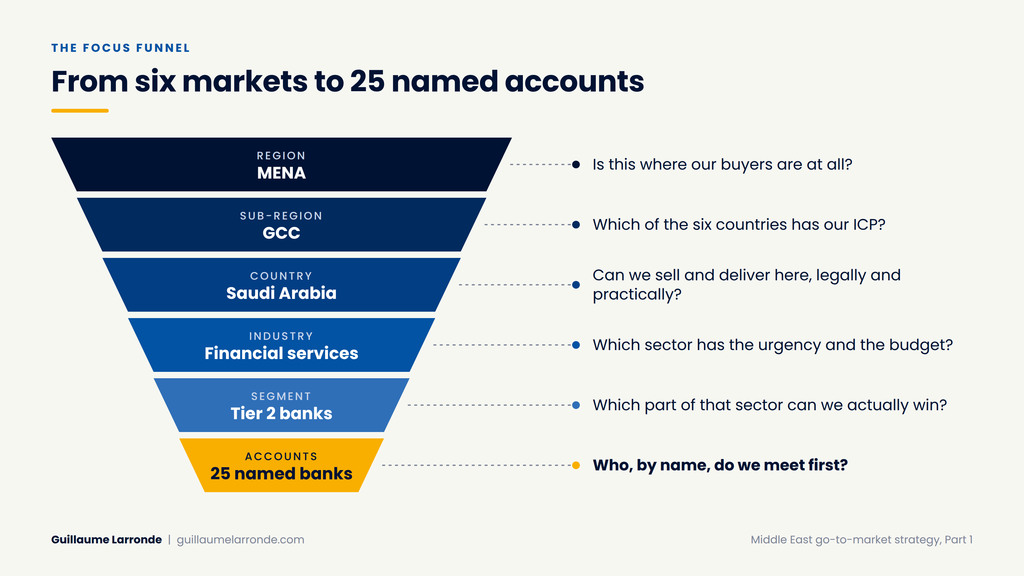
That’s why vague SaaS expansion plans fail here. A growing market attracts everyone, and the winners are the ones who knew exactly which accounts to call.
So treat the region as what it is:
- Six countries: the UAE, Saudi Arabia, Qatar, Kuwait, Bahrain and Oman, each with its own rules and buying speed.
- Two first-market candidates: for most SaaS companies, the UAE or Saudi Arabia.
- Many sectors: a Saudi bank and a Saudi retailer buy software in completely different ways.
- One real target: a named list of accounts you can sell to and serve in 24 months.
Before anything else, check why you’re going. Pull signals are evidence: existing customers with Gulf operations, inbound trials from GCC domains, RFPs you didn’t chase. Push signals are pressure: a board slide, a competitor’s Dubai press release, a three-day trip that looked promising from a hotel lobby.
Does your SaaS product travel to the GCC?
The first test in any Middle East GTM playbook is whether the product travels. A SaaS product that works perfectly at home can still fail its first Gulf security review. The questions below come up in almost every enterprise deal, so answer them before you launch.
| Question buyers will ask | Why it matters | What to have ready |
|---|---|---|
| Where is our data hosted? | Data protection and sector rules | Your hosting options, including in-region |
| Can you pass our security review? | IT and cybersecurity sign-off | Certifications, pen test summary, completed questionnaire |
| Does it work in Arabic? | End-user adoption | Arabic and right-to-left support where users need it |
| Does it integrate with our systems? | Technical approval | Integrations used by regional customers |
| Can you invoice us locally? | Procurement and finance | AED or SAR pricing, local entity, e-invoicing readiness |
| Who supports us, and when? | Operations | Coverage across both regional working weeks |
On data, Saudi Arabia’s Personal Data Protection Law became fully enforceable on 14 September 2024 and applies to companies outside the Kingdom that process the data of people in it. Cross-border transfers are allowed under conditions, but regulated buyers such as banks and government entities can add their own hosting expectations. Ask early.
Hosting options are improving. AWS says its first Saudi region is on track for December 2026, adding to its existing infrastructure in Bahrain and the UAE.
On billing, the UAE’s e-invoicing mandate goes live for businesses under AED 50 million in revenue on 1 July 2027, and Saudi Arabia already runs mandatory e-invoicing through ZATCA. If your billing stack can’t produce compliant invoices, procurement will notice before your champion does.
None of this is legal or tax advice. It’s the list to take to qualified advisers before your first regional contract.
UAE first, Saudi Arabia first, or both?
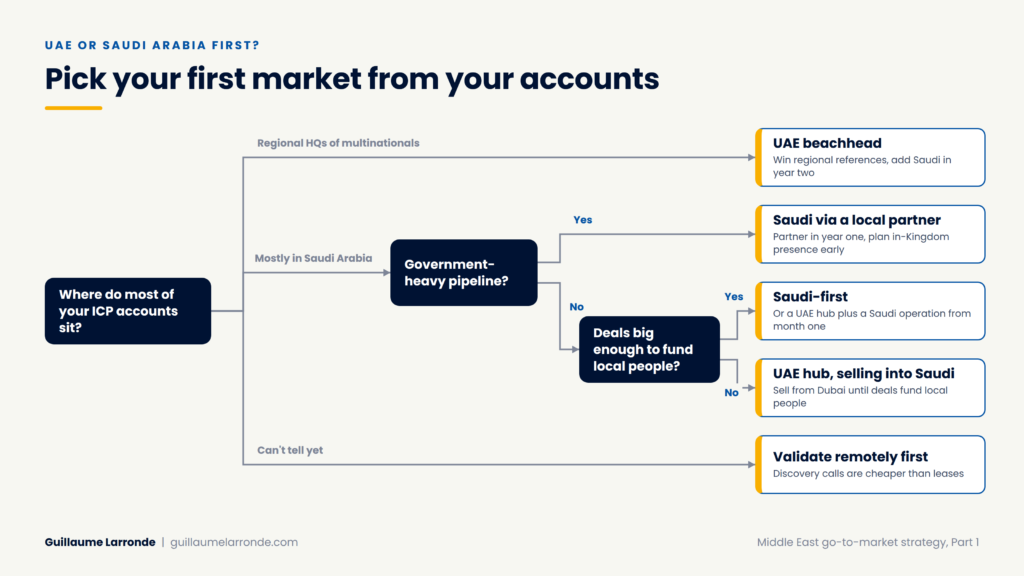
Pick the first market from your accounts. For SaaS, the decision usually comes down to who your buyers are.
| If your buyers are mostly… | Start with | Why |
|---|---|---|
| Regional HQs of multinationals | The UAE | That’s where most regional decision-makers sit |
| Saudi enterprises with large deals | Saudi-first, or a UAE hub plus a Saudi operation | The buyer base and deal sizes justify local people |
| Saudi government entities | Saudi, through a local partner in year one | Procurement favours in-Kingdom presence |
| Hard to tell yet | Remote validation | Discovery calls are cheaper than leases |
Two facts shape the Saudi government route. Since 1 January 2024, multinationals doing business with Saudi government entities have been required to base their regional headquarters in the Kingdom. In 2026, Saudi Arabia formalised exemptions, and government purchases below SAR 1 million sit outside the rule. For most SaaS startups, early government deals come in under that threshold or run through an integrator.
The underrated option is following existing customers. If a global customer already uses you and has GCC subsidiaries, sell to those first. Your first regional reference is then a customer you already have. Part 1 covers the full comparison and all five entry patterns.
Land inside a startup hub, then earn your own office
Don’t sign a lease in month one. Take a couple of desks inside a startup hub, get your licence and visas through it, and use its network while you find your feet.
| Hub | Where | Best fit for SaaS |
|---|---|---|
| AstroLabs | Dubai (JLT) and Riyadh (Al Malqa) | SaaS companies planning both the UAE and Saudi Arabia |
| in5 Tech | Dubai Internet City | Early-stage SaaS on a tight budget |
| DIFC Innovation Hub and Dubai AI Campus | DIFC, Dubai | AI and fintech SaaS selling to banks |
| Hub71 | Abu Dhabi (ADGM) | Startups ready to relocate a founder |
| The Garage | Riyadh (KACST) | SaaS building a Saudi presence early |
The numbers are startup-friendly. in5 offers incubated startups a licence at AED 1,000 a year and a coworking desk from AED 15,000 in year one. DIFC’s AI Licence is subsidised at USD 1,500 a year, including coworking access and discounted visas, which suits AI-native SaaS. Hub71 offers AED 250,000 in incentives plus AED 250,000 in cash for equity, if a founder relocates.
Two cautions for SaaS. Some free zone licences restrict direct trade with mainland customers, so check what your licence lets you invoice. And “free zone means zero tax” isn’t a plan: the UAE tax authority confirms a Qualifying Free Zone Person does not get the 0% band on the first AED 375,000 and pays 9% on non-qualifying income.
How should B2B SaaS be priced for Gulf procurement?
Pricing is the part of a Middle East GTM playbook most SaaS teams copy from home. Price for the way Gulf enterprises buy instead, which changes a few habits.
- Currency: quote in AED or SAR alongside USD, and decide who carries FX risk.
- No reflexive discount: arriving cheap signals a lower-tier product and anchors every renewal.
- Implementation fees: price them separately and honestly. Buyers expect them.
- Paid pilots: a scoped pilot with written success criteria moves enterprise deals further than a free trial.
- Annual and multi-year terms: trade term length for price, not price for nothing.
- Partner margins: build them into the price book from day one.
- Payment terms: model them into cash flow, especially with government customers.
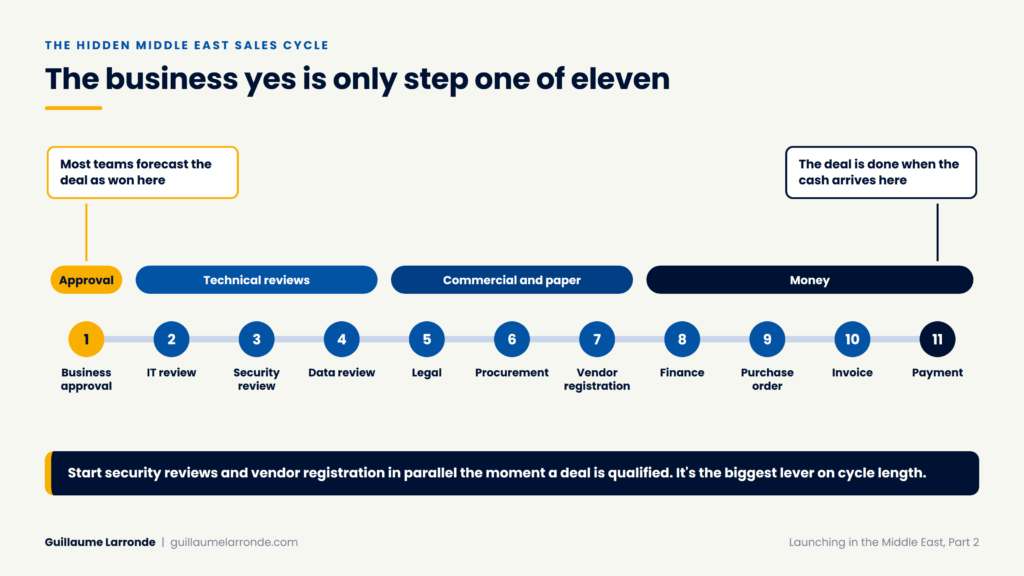
The sales cycle is longer than the “yes” suggests. After business approval come IT review, security review, data review, legal, procurement, vendor registration, finance, purchase order, invoice and payment. That’s eleven steps in total. Start the security review and vendor registration in parallel the moment a deal is qualified.
The SaaS sales motion that works in year one
In year one, the founder or CRO sells. Senior Gulf buyers expect to meet senior people, and early decisions on pricing, product gaps and partners need someone with authority in the room. Plan for at least one week a month in the region.
The motion that works for enterprise SaaS here, in my experience, is sales-led and relationship-heavy, with self-serve playing a supporting role at best:
- Build a 100-account list in three tiers: about 20 strategic, 50 core, 30 test.
- Map stakeholders by name for every Tier 1 account, including IT, security and procurement.
- Run research-led outreach and stay visible on LinkedIn, where Gulf B2B conversations happen.
- Activate two or three partners, usually integrators or resellers with access you don’t have.
- Use events for meetings, not badge scans. Book them weeks ahead.
- Choose lighthouse customers for reference value, not speed of signature.
Relationships matter, but not the way the cliché suggests. The largest deal I closed at LinkedIn, a single $1M global deal, wasn’t won on the pitch. It was won by understanding what the buyer was personally accountable for and making that easier.
Plan the team around nationalisation rules. Saudi Arabia raised Saudization to 60% for sales and marketing professions from 19 April 2026, for establishments with three or more workers in those roles, and the covered roles include ICT sales specialists. From your third seller in the Kingdom, plan for a majority-Saudi team. Part 2 has the full first-year plan.
Relationships accelerate value. They don’t replace it.
The SaaS metrics that tell you the region is working
SaaS teams love their dashboards, so pick the right numbers for the stage you’re in. Year one is about proof. Years two and three are about economics.
| Year one: proof | Years two and three: economics |
|---|---|
| Qualified pipeline by source | Net revenue retention (NRR) |
| Win rate and sales cycle length | Gross revenue retention (GRR) |
| Activated partner rate | CAC payback by channel |
| Paid pilots converted to contracts | Expansion ARR from existing accounts |
| Referenceable customers | Days sales outstanding (DSO) |
| Time to value for first customers | Forecast accuracy |
Watch DSO from the first government or semi-government customer. A region can look profitable on paper and still consume cash for months because of payment cycles.
The single best leading indicator of year-two growth is the number of customers who’ll take a reference call for you. In the Gulf, references travel fast between banks, family groups and government entities.
From beachhead to a regional SaaS engine
By year two, the question changes from “can we win here?” to “can someone other than our star seller win here?”. That’s the repeatability test, and it’s where this Middle East GTM playbook shifts from selling to systems.
- Codify the playbook: ICP, use cases, discovery, pricing rules, procurement paths, objections.
- Build regional RevOps: territories, buyer-evidence stages, attribution and a weekly forecast.
- Plan capacity with maths: revenue target ÷ productive quota, adjusted for ramp, attainment and attrition.
- Run partners as a channel: deal registration, published margins, clear rules of engagement.
- Expand by score: rate Qatar, Kuwait, Bahrain and Oman on pull, ICP density and partners before committing people.
- Write down decision rights: which calls the region makes alone, and which go back to HQ.
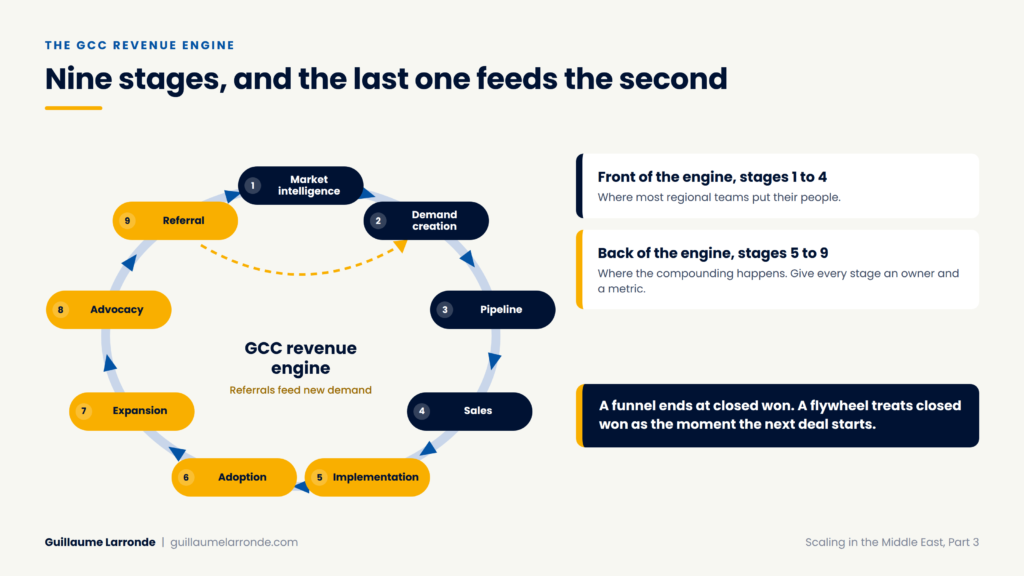
Think of it as a flywheel, not a funnel. For SaaS, the back of the engine is where the money compounds: implementation, adoption, expansion, advocacy and referral. Most regional teams staff the front and neglect the back.
| Level | Name | What it looks like for SaaS |
|---|---|---|
| 0 | Opportunistic | A few Gulf logos that found you, no owner |
| 1 | Exploring | Discovery calls, remote demos, fly-in visits |
| 2 | Beachhead | Hub licence, first paid customers, founder selling |
| 3 | Repeatable | Validated ICP, references, measured sales cycle |
| 4 | Systemised | Playbook, RevOps, active partners, customer success |
| 5 | Regional engine | Predictable growth in more than one country |
| 6 | Strategic region | Regional P&L, in-region hosting, product influence |
The 36-month SaaS roadmap for the Gulf
Each phase answers one question with evidence before the next phase spends money.
| Phase | Timing | SaaS milestone | Question to answer |
|---|---|---|---|
| Discover | T-12 to T-6 | 30 or more discovery calls, hosting answer ready | Is there a market for us? |
| Design | T-6 to launch | Entry pattern, hub, pricing and partners chosen | How should we enter? |
| Launch | Months 0 to 3 | Licence, bank, CRM, 100-account list live | Can we operate? |
| Validate | Months 3 to 6 | First paid pilots and security reviews passed | Will customers buy? |
| Prove | Months 6 to 12 | Lighthouse customers and first references | Can we win repeatedly? |
| Systemise | Year 2 | Playbook, RevOps, regional customer success | Can others reproduce it? |
| Expand | Years 2 to 3 | Second country scored and opened | Where else does it work? |
| Scale | Year 3 and beyond | Healthy NRR and CAC payback | Is this a profitable regional business? |
Don’t scale presence before you’ve scaled evidence.
Frequently asked questions about B2B SaaS in the Middle East
Do SaaS companies need to host data in Saudi Arabia?
Not automatically. Saudi Arabia’s data protection law allows cross-border transfers under conditions, but it applies to foreign companies processing Saudi residents’ data. Regulated buyers such as banks and government entities may set stricter hosting expectations, so ask in discovery and confirm the position with qualified advisers before signing.
Should a SaaS startup start in Dubai or Riyadh?
Start where your ICP accounts are. If your buyers are regional headquarters of multinationals, Dubai is usually right. If most target accounts and budget are Saudi, go to Riyadh or run a UAE hub with a Saudi operation. If you can’t tell, validate remotely before choosing either.
How should B2B SaaS be priced in the GCC?
Quote in AED or SAR alongside USD, price implementation separately, and avoid arriving with a regional discount. Scoped paid pilots with written success criteria tend to move enterprise deals further than free trials. Build partner margins and longer payment terms into the model from the start.
How long does it take to close an enterprise SaaS deal in the Middle East?
Mid-market deals can close in a few months. Enterprise and government deals often take six to twelve months or more, because security review, procurement, vendor registration and purchase orders follow the business approval. Starting security and vendor registration in parallel is the biggest lever on cycle length.
Can product-led growth work in the GCC?
For smaller teams and self-serve tools, it can bring in early users. For enterprise and government accounts, buying still runs through relationships, security reviews and procurement, so a sales-led motion does the heavy lifting. Use product-led signals to find accounts, then sell to them properly.
A Middle East GTM playbook works when SaaS companies arrive with answers as well as a product. Prove the product travels, prove the motion works, then build the engine.