
Cold outreach isn’t dying. Generic outreach is. The reply-rate collapse everyone blames on the channel is a symptom of templating at that volume, not a verdict on interrupting a stranger. What works in 2026 isn’t warmer language or a softer subject line. It’s a message built on a real signal, aimed at one person, with something in it for them before you’ve asked for anything.
In this article
- The “cold outreach is dead” claim gets the diagnosis wrong
- What changed between 2010 and 2026 isn’t the channel
- The deal that taught me persuasion doesn’t close B2B
- Three checks before you write a single line
- What “warm” actually means, and why most people get it backwards
- Your dashboard is rewarding the wrong kind of prospecting
- Is your outreach problem volume, targeting or the offer
Key takeaways
- Cold outreach isn’t dead. The reply-rate collapse is a templating problem, not a channel problem.
- AI removed the time cost of research. Skipping it is now a choice, not a constraint.
- Every message needs three things before you send it: a signal, relevance, and a stake for the reader.
- “Warm” means useful. Friendly tone doesn’t fix a message that has nothing in it.
- Activity dashboards reward volume over relevance. Fix what you measure before you fix the message.
The “cold outreach is dead” claim gets the diagnosis wrong
I hear it every few months. Someone posts a screenshot of a 0.4% reply rate and declares cold outreach finished. I don’t argue with the number. I argue with the diagnosis.
Reply rates cratered because AI made it nearly free to send at volume, so people did, without doing the work that used to gate that volume. When writing a hundred personalized emails took a week, most reps sent twenty and made them count. Now a hundred take an afternoon, and most of them read like it.
Instantly.ai’s 2026 benchmark report, built from billions of cold email sends, put the average reply rate at 3.43%, with elite performers, the top 10% of senders, exceeding 10%. That’s not a channel dying. That’s more than a three-times gap between people who still do the work and people who let a tool do it for them.
Cold outreach isn’t dead. It’s being done badly by more people, faster than ever.
Nobody built a system for reaching a stranger and made a case against contact itself. What broke is the assumption that volume was ever the constraint. It wasn’t. Attention was, and attention doesn’t get more available because the sending got cheaper.
What changed between 2010 and 2026 isn’t the channel
In 2010 I joined LinkedIn as the first French sales hire, launching Corporate Solutions in a market where Viadeo, the local incumbent, had roughly ten times more users. Nobody was waiting for us. A generic pitch about “professional networking” would have gone nowhere, because Viadeo already owned that story.
What worked was finding the one thing Viadeo genuinely couldn’t do for a company, an international hiring or business-development use case tied to a global network, and building the outreach around that. Building that case for one prospect took hours. There was no shortcut. So most people skipped it, and the ones who didn’t stood out by default.
That’s the part that’s different now. AI did to prospecting research what the calculator did to accounting. The arithmetic got free. Pulling a company’s recent funding round, a leadership change, a product launch, a competitor’s move, that used to cost real time. Now it costs a prompt.
The people still sending generic outreach in 2026 aren’t skipping research because they can’t afford it. They’re skipping it because volume still feels like the safer bet, and old habits outlast the constraint that created them. The differentiation moved from who has time to research to who bothers to use what the research actually tells them.
The deal that taught me persuasion doesn’t close B2B
Between 2012 and 2016, running sales for LinkedIn in the Middle East, I closed the largest deal of that period: a $1M global agreement, part of $7M+ I closed across those years. I’d love to tell you it came from a sharp pitch. It didn’t.
It came from noticing what the buyer was personally accountable for inside their own organization, a global rollout their leadership was watching closely, and making that specific thing easier. The pitch mattered less than the fact that I understood their actual problem before I asked for anything.
That lesson doesn’t live only at the closing table. It lives at the first message. A prospecting note that shows you understand what someone is accountable for right now reads completely differently from one that shows you found their name on a list. Persuasion is what you reach for when you don’t have anything useful to say yet. Usefulness closes what persuasion can’t.
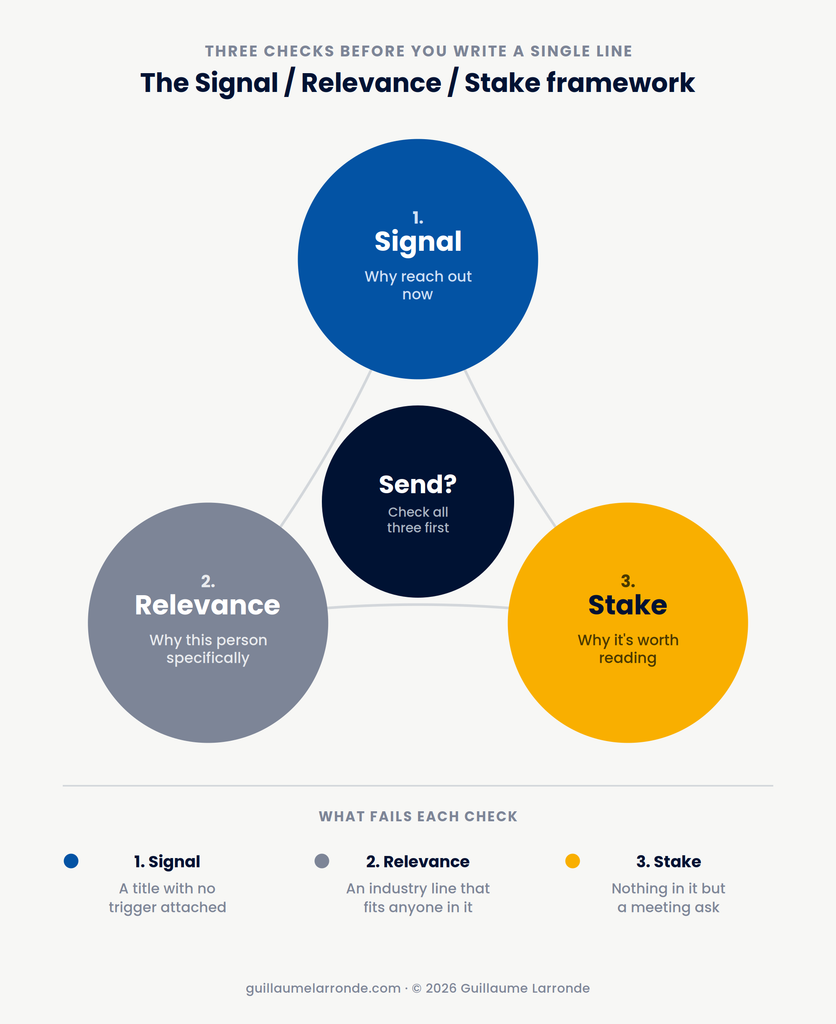
Three checks before you write a single line
Most outreach fails one of three tests, and most people never check which one before they hit send. Run these in order. If a message fails any of them, it isn’t ready, no matter how polished the copy is.
- Signal. Is there a real, specific reason to reach out to this person now? A funding round, a leadership change, a role posted, a public comment they made. A job title is not a signal. “You’re a VP of Sales” describes ten thousand people. It tells the reader nothing you couldn’t have learned in five seconds.
- Relevance. Does the message show you understand their situation, not their industry? “Companies like yours struggle with X” is an industry observation. “I noticed you just opened a Riyadh office and your last three hires were in enterprise sales” is relevance. One could be sent to anyone. The other could only be sent to them.
- Stake. Is there something in this message for them even if they never reply? A specific number, a comparison, a fact about their own business they didn’t have five minutes ago. If the only value in your message is “let’s chat,” you’re asking them to do the work of finding out why that’s worth their time.
| Check | What it answers | What fails it |
|---|---|---|
| Signal | Why reach out now | A title with no trigger attached |
| Relevance | Why this person specifically | An industry line that fits anyone in it |
| Stake | Why it’s worth reading | A message with nothing but a meeting ask |
The Digital Bloom’s 2025 cold outbound benchmark study, surveying decision-makers directly, found that 71% of ignored cold emails were dismissed for lacking relevance. Not for being cold. For being generic. That’s the whole argument in one number.
None of this requires more time than a bad email takes to write. It requires doing the research AI already made cheap, then actually using it instead of pasting a name into a template.
What “warm” actually means, and why most people get it backwards
“Warm outreach” gets sold as a tone. Friendlier subject lines, an exclamation mark, “hope you’re doing well.” I think that’s backwards, and it explains why so much “warm” outreach still gets ignored.
Warm isn’t how a message sounds. It’s whether the reader recognizes their own situation in the first two lines. A blunt, short note built on a real signal reads as warm because it’s useful. A friendly, softly worded message with nothing behind it still reads as cold, because the reader can tell nobody did any work before writing it.
- Reads cold: “Hope this finds you well! I wanted to reach out because I think we could really help companies like yours.”
- Reads warm: “Saw you just closed your Series B. Teams at that stage usually hit a specific hiring bottleneck around month three. Here’s what that looked like for two companies I’ve worked with.”
Same word count, roughly. Completely different read. The second one didn’t need to be friendly. It needed to be right.
Your dashboard is rewarding the wrong kind of prospecting
Here’s the part nobody talks about when they push a team to “warm up” their outreach: most sales dashboards still measure the exact behavior that produces cold, generic messages. Emails sent. Calls made. Activity logged.
Counting calls and emails to judge prospecting quality is like weighing a suitcase to find out if you packed the right things. The number is real. It tells you nothing about whether the trip goes well.
If a rep’s only visible metric is volume, volume is what they’ll optimize for, and the fastest way to hit a volume number is to stop doing the research that made the last version work. The dashboard doesn’t distinguish a message built on a real signal from one that wasn’t. So it rewards both equally, and the team drifts back toward whichever one is faster to produce.
What’s worth tracking instead:
- First-touch reply rate, not total emails sent
- Positive reply rate, not just any response
- Meetings sourced from cold outreach specifically, not blended with inbound
- Reply rate by signal type, so you learn which triggers actually work for your product
Is your outreach problem volume, targeting or the offer?
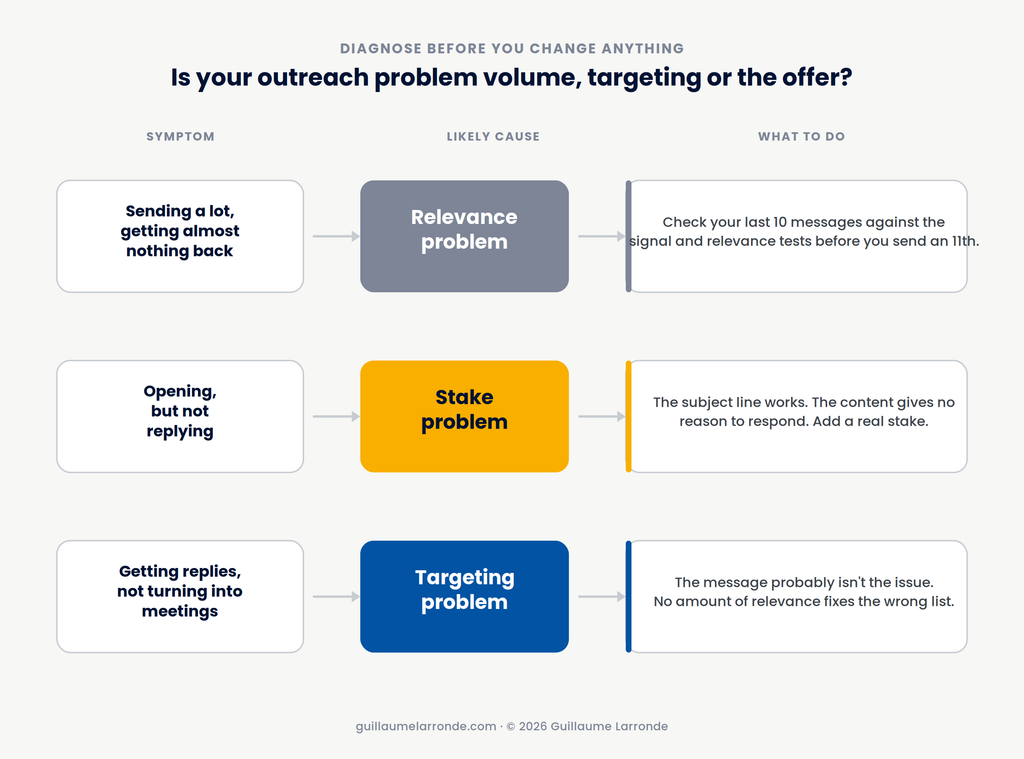
Before changing anything, diagnose which of the three it actually is. Fixing the wrong one wastes a quarter.
- If you’re sending a lot and getting almost nothing back: the problem is usually relevance, not volume. Check the last ten messages against the signal and relevance tests above before you send an eleventh.
- If people are opening but not replying: the problem is usually stake. The message has a subject line that works and content that gives the reader no reason to respond.
- If you’re getting replies but they’re not turning into meetings: the problem probably isn’t the message. It’s who you’re targeting. No amount of relevance fixes a list built on the wrong titles.
Frequently asked questions about cold outreach in 2026
Is cold outreach still effective for B2B sales in 2026?
Yes, for the people still doing the research before they write. The average reply rate sits around 3.43%, and elite senders, the top 10%, exceed 10% on the same channel with a real signal behind each message.
What’s the actual difference between cold and warm outreach?
Warm outreach usually means a prior connection or referral. But tone-warm generic outreach performs no better than cold outreach. What matters is whether the message shows real understanding of the reader’s situation, regardless of how the relationship started.
How long should a cold prospecting message be?
Short. A message built on a genuine signal doesn’t need length to prove its relevance, the signal does that. If you’re padding a message to make it feel thorough, that’s usually a sign the signal isn’t strong enough yet.
Should AI write cold outreach messages?
AI is excellent at the research: funding rounds, leadership changes, recent news. It’s poor at judging which of those signals actually matters for your specific offer. Use it to gather, not to decide what’s worth saying.
What’s a good B2B cold email reply rate in 2026?
Benchmark reports put the average around 3 to 5%. Instantly’s 2026 report puts elite senders, the top 10%, above 10%. The Digital Bloom’s 2025 hook-optimized study found top-quartile campaigns reaching 15 to 25%. The gap between average and top performers is almost entirely about targeting and relevance, not volume.
Cold outreach never stopped working. What stopped working was sending the same message to everyone and calling the volume a strategy. The reply-rate collapse isn’t a channel dying. It’s a filter doing its job.
This week, pull your last ten sent prospecting messages and run them against the three checks: signal, relevance, stake. Whatever fails, that’s where your next hour goes, not into writing more messages.