
AI has changed the way B2B buyers research and make decisions and of course has change the way sellers sell. From email outreach, territory planning, meeting prep or followups, all the way to forecasting and sales coaching. But what are the sales tasks to automate with AI fully, should be AI-assisted or remain human?
To show where the line sits, I’ve listed the 20 tasks in an account executive’s week, grouped them into ten categories, and marked what AI does to each one. I sort them with three questions I call the arithmetic test.
It comes from two halves of my own work. I closed more than $7M at LinkedIn, and since 2023 I’ve been building AI sales systems that can be tailored and scaled.
In this article
- Most of a seller’s week isn’t selling, and that’s the part to hand over
- The 20 tasks that fill an account executive’s week
- The arithmetic test: three questions before I hand a task to AI
- The sales tasks I’d automate with AI, task by task
- The five moments I’d never automate, whatever the tool can do
- Before and after: the same 40 hours once AI takes the arithmetic
- Why do teams save five hours a week and get nothing back?
- Where should a sales team start?
Key takeaways
- An account executive’s week is 20 tasks. Only seven of them happen in front of a buyer.
- Five tasks can be fully automated, nine are AI-drafted and human-decided, and six stay human.
- In my model, AI frees 11 hours of a 40-hour week if you let it take the arithmetic.
- Reinvested, that moves customer meetings from 22% of the week to 50%.
- Gartner found AI saves sellers 4.8 hours a week today, and 72% of organisations don’t reinvest the time.
Most of a seller’s week isn’t selling, and that’s the part to hand over
Bain’s Technology Report 2025 says sellers may spend only about 25% of their time actually selling to customers. Salesforce’s State of Sales survey of 4,050 sales professionals, published in February 2026, puts the average at 40%.
McKinsey’s July 2026 report on B2B sales describes a materials company where sellers spent 20% of their time with customers. Successful B2B sales teams, it says, manage one-third to one-half.
The methods differ and so do the definitions. Salesforce is the only one of the three that splits the week by activity. This is the average rep in its 2026 report:
| Activity | Share of the week |
|---|---|
| Meeting with customers | 22% |
| Prospecting | 18% |
| Creating quotes | 17% |
| Planning | 16% |
| Manually entering data | 13% |
| Training | 11% |
| Other | 3% |
The first two lines add up to that 40% selling figure.
Two things have no line of their own: internal meetings and email. They have to be in there somewhere, folded into planning and other.
That hidden work is what AI is good at. Gong’s State of Revenue AI 2026 report, built on a survey of 3,048 revenue leaders, ranks less admin time (data entry, note-taking, CRM updates) as the top impact of AI on their teams.
The 20 tasks that fill an account executive’s week
So I went bottom-up. This is the week of an account executive or account manager. I’ve left BDRs out, because their week is a different shape.
Twenty tasks, in the order a deal meets them:
| Tasks 1 to 7 | Tasks 8 to 14 | Tasks 15 to 20 |
|---|---|---|
| 1. Discovery calls | 8. Customer emails and follow-ups | 15. Account and territory planning |
| 2. Demos and presentations | 9. Scheduling meetings | 16. Call notes and CRM updates |
| 3. Negotiation and closing calls | 10. Account research | 17. Expenses and admin |
| 4. Account reviews with customers | 11. Call prep and agendas | 18. Forecast and pipeline reviews |
| 5. Finding accounts and contacts | 12. Proposals and decks | 19. Meetings with other teams |
| 6. Writing outreach messages | 13. Quotes and pricing | 20. Training and everything else |
| 7. Cold calls and follow-up calls | 14. Internal approvals |
I’ve done every one of these with a number to hit. Only the first seven happen in front of a buyer.
Grouped into ten categories, this is where the 40 hours go
Twenty tasks is too many to manage, so I grouped them into ten categories and gave each one a share of a 40-hour week.
The shares are my working model. They’re anchored on the Salesforce split, with internal meetings and email pulled out into their own lines.
| Category | Tasks in it | Share | Hours |
|---|---|---|---|
| 1. Customer meetings and calls | discovery calls, demos and presentations, negotiation and closing calls, account reviews with customers | 22% | 8.8h |
| 2. Prospecting and outreach | finding accounts and contacts, writing outreach messages, cold calls and follow-up calls | 12% | 4.8h |
| 3. Customer email and scheduling | customer emails and follow-ups, scheduling meetings | 6% | 2.4h |
| 4. Research and call prep | account research, call prep and agendas | 8% | 3.2h |
| 5. Proposals, quotes and approvals | proposals and decks, quotes and pricing, internal approvals | 10% | 4.0h |
| 6. Account and deal planning | account and territory planning | 6% | 2.4h |
| 7. CRM updates and admin | call notes and crm updates, expenses and admin | 12% | 4.8h |
| 8. Forecast and pipeline reviews | forecast and pipeline reviews | 6% | 2.4h |
| 9. Other internal meetings | meetings with other teams | 9% | 3.6h |
| 10. Training and miscellaneous | training and everything else | 9% | 3.6h |
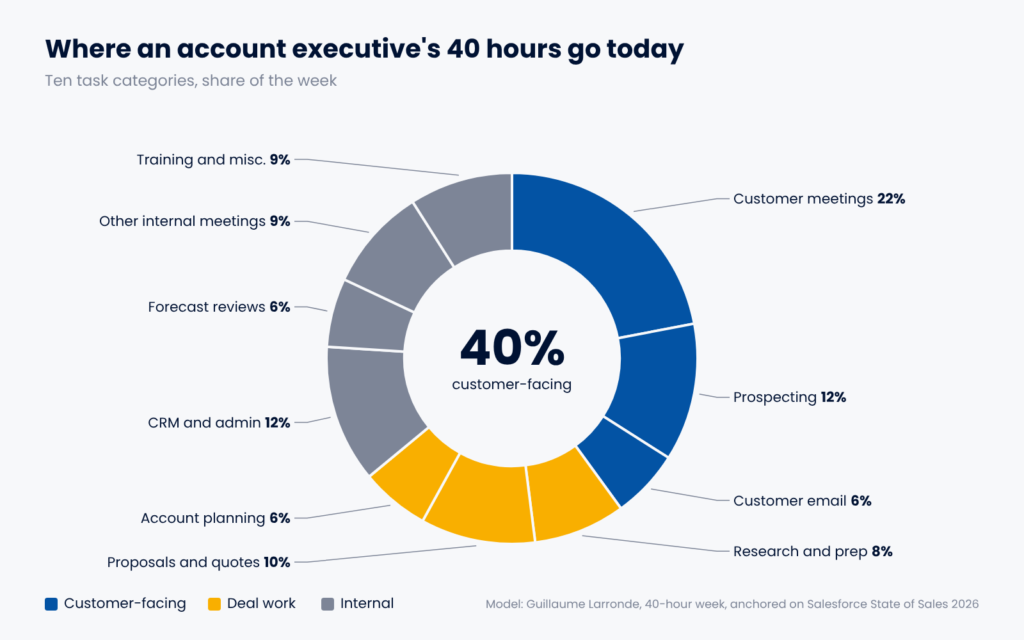
Three numbers fall out of that table:
- Customer-facing work: 40% of the week, the same as Salesforce’s selling figure.
- Deal work behind the scenes: 24%. Research, proposals, quotes, approvals and planning.
- Internal work: 36%. CRM, admin, forecast calls, other meetings and training.
Internal meetings alone are six hours, 15% of the week. Some of that can’t be compressed. A company needs its forecast call and its team meeting, and no tool will cancel them.
The arithmetic test: three questions before I hand a task to AI
AI did to commercial work what the calculator did to accounting. The arithmetic got free. The judgement got more valuable.
So before I hand any of the 20 tasks over, I ask three questions. I call it the arithmetic test.
- Is it arithmetic or judgement? Gathering, sorting, summarising and formatting are arithmetic. Deciding what matters to this buyer is judgement.
- Does a person read it before the buyer does? If yes, a mistake costs me two minutes. If no, it can cost the account.
- Who answers for it in the room? If the buyer will hold me to it, I do it myself.
The answers give three levels.
| The task is | Level | Examples |
|---|---|---|
| Arithmetic, checked by a person | Automate it fully | Call notes, CRM updates, scheduling |
| Arithmetic, but the buyer sees it | AI drafts, I decide | Follow-up emails, proposals, quotes |
| Judgement | Human, AI preps | Discovery, negotiation |
AI can prepare me for the room. It can’t sit in it for me.
Here’s the thing about the middle level. It’s where the trouble starts. Skip the edit and you’re back to templates, sent faster.
The sales tasks I’d automate with AI, task by task
Run all 20 tasks through the test and this is where they land.
- Automate: 5 tasks. Finding contacts, scheduling, account research, CRM updates and admin.
- AI drafts, I decide: 9 tasks. Outreach, emails, call prep, proposals, quotes, approvals, planning, forecast reports and training.
- Human, AI preps: 6 tasks. Every call and meeting with a buyer, plus the meetings with other teams.
| Task | Level | What stays with me |
|---|---|---|
| 1. Discovery calls | Human, AI preps | The questions and the listening |
| 2. Demos and presentations | Human, AI preps | The room |
| 3. Negotiation and closing calls | Human, AI preps | Every concession |
| 4. Account reviews with customers | Human, AI preps | The relationship |
| 5. Finding accounts and contacts | Automate | The targeting rules |
| 6. Writing outreach messages | AI drafts, I decide | The opening line, and the send button |
| 7. Cold calls and follow-up calls | Human, AI preps | The call itself |
| 8. Customer emails and follow-ups | AI drafts, I decide | Every word before it goes |
| 9. Scheduling meetings | Automate | Nothing |
| 10. Account research | Automate | The one fact I’ll open with |
| 11. Call prep and agendas | AI drafts, I decide | The three questions that matter |
| 12. Proposals and decks | AI drafts, I decide | The argument and the numbers |
| 13. Quotes and pricing | AI drafts, I decide | The price I’m willing to defend |
| 14. Internal approvals | AI drafts, I decide | The case I make to finance or legal |
| 15. Account and territory planning | AI drafts, I decide | Which accounts get my time |
| 16. Call notes and CRM updates | Automate | Stage and close date |
| 17. Expenses and admin | Automate | A monthly glance |
| 18. Forecast and pipeline reviews | AI drafts, I decide | The number I commit |
| 19. Meetings with other teams | Human, AI preps | Showing up prepared |
| 20. Training and everything else | AI drafts, I decide | The practice |
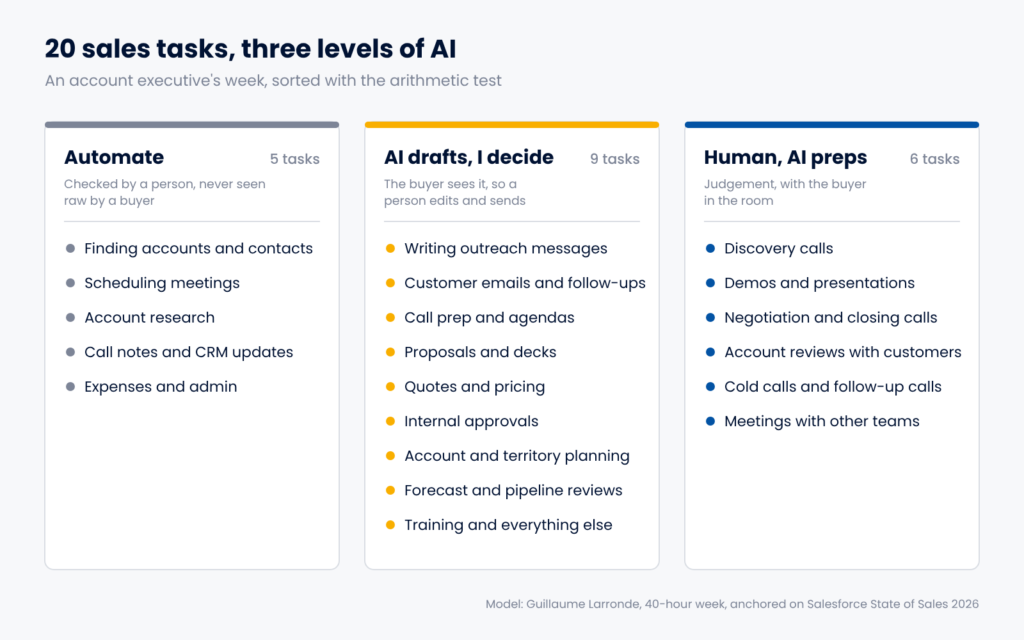
The five automated tasks are work nobody was doing well anyway. That’s my first filter for any AI tool in a commercial function.
What the research says about these tasks
Gartner predicts that by 2027, 95% of sellers’ research workflows will begin with AI, up from less than 20% in 2024.
In the Salesforce survey, sellers expect agents to cut prospect research time by 34% and email drafting by 36% once they’re fully in place. That’s what sellers expect, which isn’t the same as what they’ll get.
Three more data points:
- Drafts and summaries: BCG reported in October 2025 that roughly seven in ten sellers already use general-purpose AI tools for drafting emails and summarising calls.
- Inbound leads: Salesforce says its own agents contacted 130,000 leads and created 3,200 opportunities in four months. It’s a vendor reporting on its own product, so read it that way.
- Next-best-action nudges: Gartner’s 2026 survey of 227 chief sales officers found organisations that give sellers AI-enabled next best actions are 2.6x more likely to achieve commercial growth.
I ran AI and automation pilots while building a commercial function from zero at a boutique professional-services firm in Dubai. One was a programmatic SEO build of more than 60 service pages.
Building where nothing exists shows you quickly which parts of the playbook were load-bearing and which were habit. The habits are the first things I’d hand to a machine.
The five moments I’d never automate, whatever the tool can do
Six of the 20 tasks stay human. Inside the AI-drafted ones there are moments I’d keep too. These are the five I’d defend hardest.
- Discovery: AI writes my prep. I ask the questions and I listen to the answers.
- The first message to a senior buyer: AI does the research and a draft. I write the line that proves I did the homework, and I press send.
- Negotiation: AI can model the price. The concession is a trade between two people who’ll work together afterwards.
- The forecast commit: AI builds the forecast. A person commits the number, because a forecast is a promise somebody has to keep.
- Bad news: the delay, the price rise, the mistake. I pick up the phone.
Buyers say the same thing in the data. In May 2026 Gartner published a survey of 645 B2B buyers. Compared with GenAI, buyers were:
- 39 percentage points more likely to say a sales rep understood their needs
- 32 points more likely to say a rep made them feel confident in the decision
- 28 points more likely to say a rep helped them move to the next step
The same buyers aren’t asking for more sales calls. In that survey, 67% prefer a rep-free experience, and 69% still prefer to validate AI-generated insights with a sales rep.
Both are true at once. Buyers want to research alone and have a person there when the decision gets risky. Gartner also predicts that by 2030, 75% of B2B buyers will prefer sales experiences that prioritise human interaction over AI. That one is a forecast, so hold it loosely.
From experience, that risky moment is where large deals are decided. I closed a $1M global deal at LinkedIn, and what it taught me is that large deals are almost never won on the pitch. They’re won by understanding what the buyer is personally accountable for and making that easier.
You won’t find that in a database. A person tells you, once they trust you.
It matters even more where I work. When I moved to Dubai in 2012 as one of three people launching LinkedIn in the Middle East, the headquarters motion didn’t account for how much relationships drive buying here. The sequence that worked was relationship first, use case second, procurement third.
Automate the first step in the Gulf and there’s no second step.
I know this cuts against the mood. In Gong’s survey, seven in ten enterprise revenue leaders say they trust AI to regularly make business decisions. On the forecast commit, I’m with the other three.
Before and after: the same 40 hours once AI takes the arithmetic
Now put the levels back on the week. I cut each category by how much of it is arithmetic, then moved every saved hour into customer meetings.
| Category | Today | Change | With AI |
|---|---|---|---|
| Customer meetings and calls | 8.8h | No cut | 19.9h |
| Prospecting and outreach | 4.8h | 35% less | 3.1h |
| Customer email and scheduling | 2.4h | 35% less | 1.6h |
| Research and call prep | 3.2h | 50% less | 1.6h |
| Proposals, quotes and approvals | 4.0h | 35% less | 2.6h |
| Account and deal planning | 2.4h | 25% less | 1.8h |
| CRM updates and admin | 4.8h | 70% less | 1.4h |
| Forecast and pipeline reviews | 2.4h | 30% less | 1.7h |
| Other internal meetings | 3.6h | 15% less | 3.1h |
| Training and miscellaneous | 3.6h | 10% less | 3.2h |
| Total | 40.0h | 11.1h moved | 40.0h |
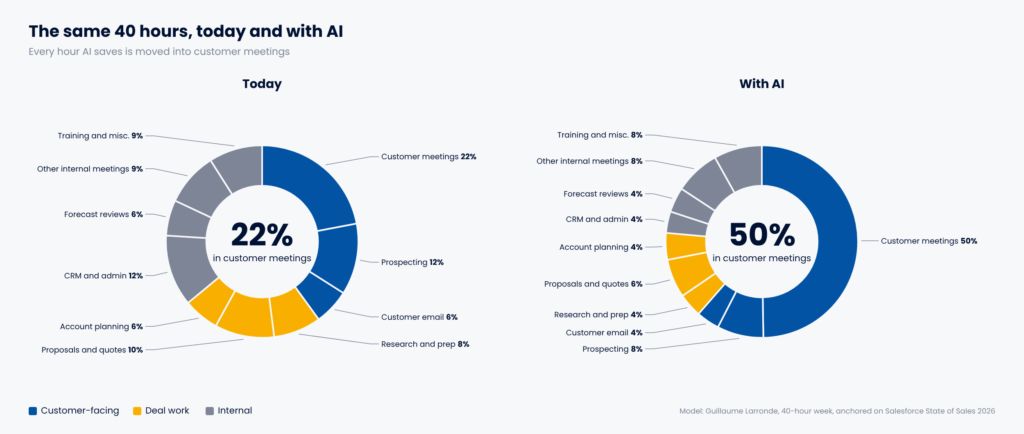
Same 40 hours, different week:
- Customer meetings and calls: from 22% of the week to 50%.
- All customer-facing work: from 40% to 61%.
- Internal work: from 36% to 24%.
- CRM updates and admin: from 4.8h to 1.4h, the biggest single cut.
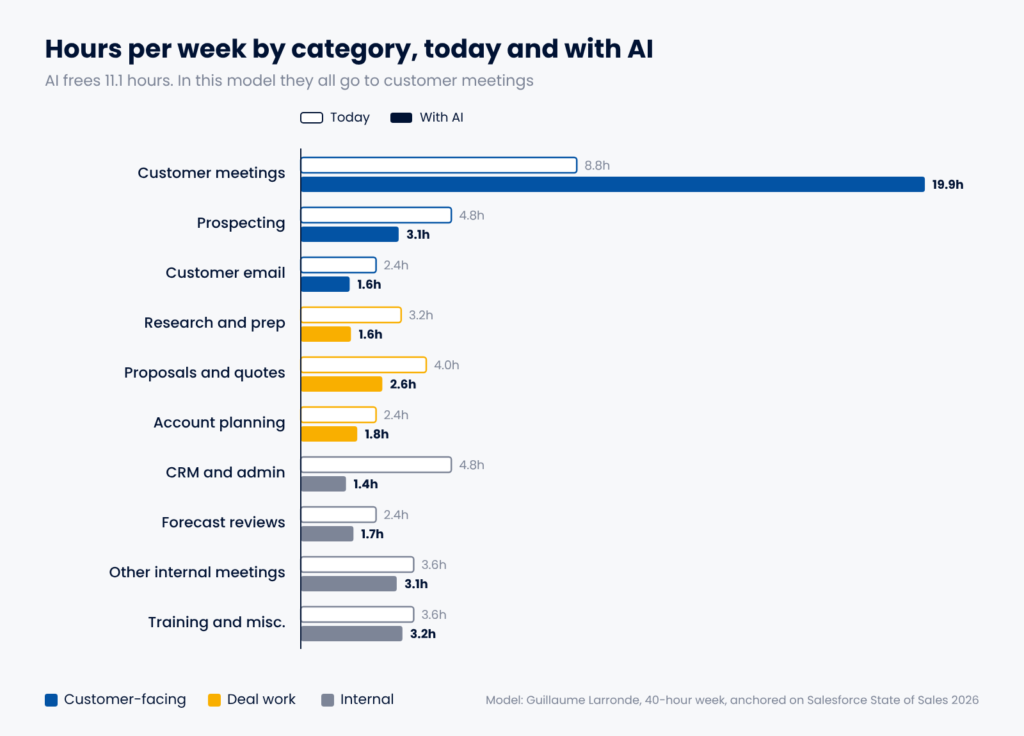
Internal meetings barely move. Six hours becomes 4.7. AI writes the notes and builds the forecast report, and the meeting still happens.
How much of this is real today
The cuts are my assumptions, so read the chart as a ceiling. Here’s what they lean on:
- Research and drafting: the 34% and 36% cuts Salesforce’s sellers expect from agents.
- The total: 11.1 hours a week. LinkedIn’s own analysis from November 2024 puts it at 11.5 hours, about 29% of a seller’s time, from automating research, CRM updates and admin.
- The direction: Bain says AI could double the time sellers spend selling.
- The reality check: Gartner measured 4.8 hours saved per seller per week in early 2026.
So the average team is less than halfway to the second chart. And the hours it has saved mostly haven’t gone to customers.
Why do teams save five hours a week and get nothing back?
Gartner surveyed 210 chief sales officers and senior sales leaders in early 2026. AI was saving their sellers an average of 4.8 hours a week. And 72% of those organisations reported low reinvestment of that time into high-value sales activities.
The ones that did reinvest were 2.2x more likely to exceed customer growth goals. The spread in returns is wide too: 25% report a return of 50% or more on their AI investment, and 20% report a negative return of 50% or more.
Saved hours are activity, and activity is not pipeline. Three things sit behind the gap, and each one shows up in the research:
- Nobody decided what the hours were for: so the week fills back up with whatever was already there.
- The process was unclear before the tool arrived: Bain’s line is “Automating mediocre processes only accelerates mediocre outcomes.”
- The data is wrong: BCG found more than four in five sellers cite inaccuracy and poor data integration as obstacles, so they double-check everything.
Salesforce found the same on data: 51% of sales leaders with AI say disconnected systems are slowing their AI initiatives.
Adding a tool to an unclear process is putting a faster engine in a car with no steering. You arrive at the wrong place sooner.
I learned this on my own work. I built an AI content system with a bank of 84 topics and 594 post angles, a voice standard and an anti-AI writing standard. The tool was never the constraint. The constraint was the raw material and the standard.
A system with no experience bank produces fluent nothing. A research brief built on an empty CRM is the same thing in a sales team.
Where should a sales team start?
Start small, and start with one rep’s real week.
- List the week: write down everything your best rep did last week, line by line. Use the 20 tasks as a checklist.
- Run the test: mark each line automate, AI drafts or human, and note who reads the output.
- Pick one task: choose one from the automate column. Call notes and account research are the safest two.
- Name the hours: decide what the saved time is for before you switch anything on. Two more discovery calls a week is a good answer.
- Check at 30 days: test it against your real pipeline. A demo proves nothing about your data.
Training matters more than the licence. In Gartner’s survey of chief sales officers, organisations that prioritise upskilling sellers on AI are 2.4x more likely to achieve strong revenue growth.
It’s tempting to do all this in reverse: buy the platform, switch everything on, then ask what changed.
Frequently asked questions about automating sales tasks with AI
Which sales tasks should you automate with AI first?
Start with work that is gathering, sorting and typing, and that a person still checks: call notes, CRM updates, account research and scheduling. They save time quickly, mistakes are cheap to catch, and no buyer sees the output before a human has read it.
How does an account executive spend a typical week?
Salesforce’s 2026 State of Sales report puts the average rep at 22% meeting customers, 18% prospecting, 17% creating quotes, 16% planning, 13% entering data and 11% training. In my own model of a 40-hour week, customer-facing work is 40%, deal work behind the scenes 24% and internal work 36%.
Will AI replace sales reps?
It will replace parts of the job before it replaces people. In Gong’s State of Revenue AI 2026 survey, 43% of revenue leaders expect AI to transform jobs without reducing headcount and 28% expect job eliminations. The admin shrinks. Discovery, negotiation and trust become a bigger share of what a rep is paid for.
How much time does AI save a salesperson?
Gartner’s 2026 survey of 210 sales leaders found AI saves sellers an average of 4.8 hours a week. LinkedIn’s analysis puts the potential at 11.5 hours. But 72% of organisations report low reinvestment of that time into high-value sales activities, so decide in advance what the hours are for.
Can AI run cold outreach on its own?
It can send it, and I wouldn’t let it. AI is good at researching an account and drafting a first version. A message nobody read, sent to a whole list, is a template with better grammar, and templates are why reply rates collapse. A person should edit and send anything a senior buyer will see.
AI made the arithmetic of selling free. The judgement is what buyers still pay for, and it’s the part of the job I’d never hand over.