
Your first 12 months in the Middle East aren’t about scaling. They’re about proving which customers, messages, channels and prices deserve to scale. When launching in the Middle East, that means a founder-led beachhead, 100 named accounts, three to five lighthouse customers, and a monthly review of where you win disproportionately.
In 2012 I was one of three people who opened LinkedIn in the Middle East. No playbook, no brand recognition in enterprise, and a region where relationships drove buying in ways our headquarters motion didn’t account for.
Later, at a Dubai agency, I closed the company’s first Saudi client and ran a pipeline of 44 opportunities worth 7.5M AED. Both times the first year was the same job: turn hypotheses into evidence, fast.
This is Part 2 of a three-part series. Part 1: Entering the Middle East covers the 6 to 12 months of preparation before launch. Part 2, this article, covers the first 12 months on the ground. Part 3: Scaling in the Middle East covers years two and three.
In this article
- Year one exists to prove what deserves to scale
- Months 0 to 3: establish the beachhead before you chase deals
- Build a sales motion where relationships carry value
- Pursue named accounts, and treat events as a revenue channel
- Build a regional marketing engine that people and answer engines can find
- Partners and lighthouse customers start the flywheel
- What does the real Middle East sales cycle look like?
- Qualify hard and forecast from buyer evidence
- Customer success and customer stories are the other half of the flywheel
- Months 6 to 12: find the pattern, then double down
- The year-one dashboard and the four-outcome review
Key takeaways
- Year one proves eight things: ICP, problem, pricing, message, motion, channels, implementation and retention.
- Founders and executives must sell in the region personally. One hire alone can’t carry the experiment.
- Relationships accelerate value in the Gulf. They don’t replace it.
- The real sales cycle runs through security, procurement, vendor registration, PO and payment. Forecast it.
- Lighthouse customers start the flywheel. Choose them for reference value, not for speed of signature.
Year one exists to prove what deserves to scale
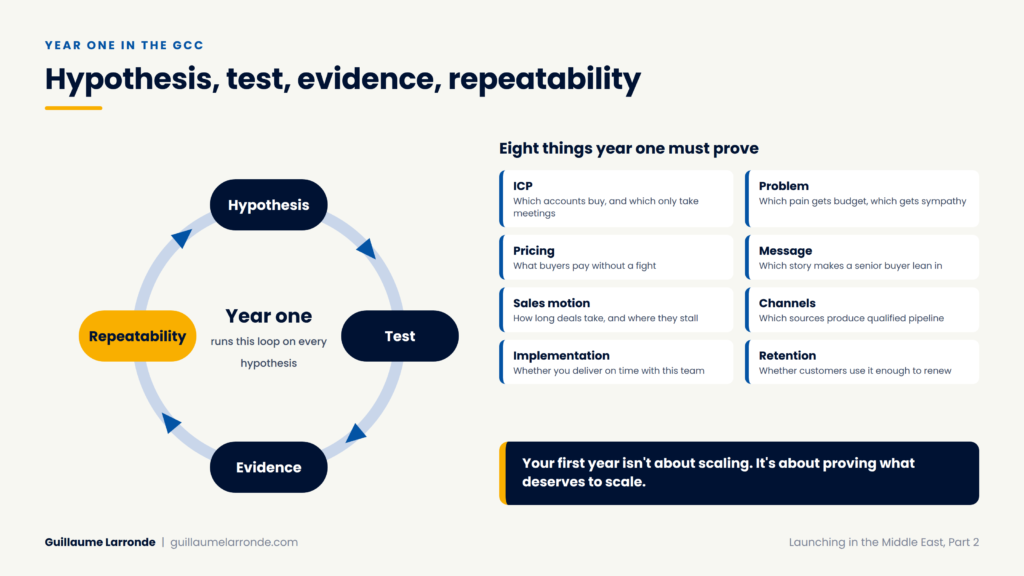
Revenue matters in year one of launching in the Middle East. It just isn’t the only thing you’re buying with the money. By month 12 you should have evidence on eight questions:
- ICP: which accounts buy, and which only take meetings?
- Problem: which pain gets budget here, which only gets sympathy?
- Pricing: what do buyers pay without a fight, and what triggers procurement pushback?
- Message: which story makes a senior buyer lean forward?
- Sales motion: how long does a deal take, and where does it stall?
- Channels: which of outbound, partners, events and referrals produce qualified pipeline?
- Implementation: can you deliver on time with the team you have?
- Retention: do customers use the product enough to renew and refer?
Each one moves through the same loop: hypothesis, test, evidence, repeatability. A hypothesis is what you believed in Part 1. A test is a real deal or a real campaign. Evidence is a result you’d defend to your board. Repeatability is getting the same result twice without the founder in the room.
Your first year isn’t about scaling. It’s about proving what deserves to scale.
Months 0 to 3: establish the beachhead before you chase deals
The operating checklist for the first 90 days
The first quarter of launching in the Middle East is plumbing. Get it done fast so it doesn’t eat the rest of the year.
- Entity or EOR: licence issued, or employer of record contract signed for your first hire.
- Bank account: opened, which can take longer than the licence, so start early.
- Visas: for the first hire and any founder who’ll be based in the region.
- Office: a couple of desks in a startup hub such as AstroLabs, in5, the DIFC Innovation Hub, Hub71 or The Garage (compared in Part 1).
- Contracts: local templates for customers, partners and employees, reviewed by local counsel.
- CRM: territories, stages and fields set up for the region from day one.
- Pricing: regional price books in USD, AED and SAR approved.
- Marketing basics: regional landing page, LinkedIn presence for the founder and first hire, first case study.
- Target accounts: the 100-account list below, loaded in the CRM.
- Partner list: ten candidates scored, three in active conversation.
- Events: the next six months of events mapped, with two chosen.
Build the first 100-account list in three tiers
The list is the plan. Everything else in year one points at it. Split it into three tiers (the numbers are illustrative, adjust to your deal size):
| Tier | Count | Who | Motion |
|---|---|---|---|
| Tier 1, strategic | About 20 | Best-fit, highest-value, reference-worthy accounts | Full account-based approach, executive involvement |
| Tier 2, core ICP | About 50 | Strong fit, standard deal size | Outbound, social selling, events, partner intros |
| Tier 3, test | About 30 | Adjacent segments from ICP B and C | Light-touch tests with a clear end date |
For each Tier 1 account, map the stakeholders by name: user, champion, business sponsor, IT and security, procurement, economic buyer, and anyone at regional or global HQ with a veto. If you can’t name at least four people, you don’t know the account yet.
Founders and executives have to be in the room
Don’t hire one salesperson and outsource the entire Middle East experiment to them. It’s the failure pattern I’d warn against first, and it fails even when the hire is excellent.
Senior Gulf buyers expect to meet senior people. And the early decisions about pricing, product gaps and partners can’t be made by someone without authority. So in year one, the CEO, CRO or VP Sales should personally own:
- The top ten strategic accounts
- The first two or three partner relationships
- The events where executives meet executives
- Any government or semi-government relationships
- The first customers, from first meeting to signature
In practice that means a founder or executive in the region at least one week a month. It’s expensive. It’s cheaper than a failed market.
A common objection is “we don’t have a network there”. I built from zero twice, in France in 2010 and in Dubai in 2012, in markets where I knew almost nobody. The network is an output of method, not a precondition.
Build a sales motion where relationships carry value
A Middle East sales strategy that works in year one runs on several channels at once, with relationships carrying them from one stage to the next.
Nine channels, and how they feed each other
- Outbound: research-led, personalised, multi-threaded outreach to Tier 1 and 2.
- Inbound: content and search that bring regional buyers to you.
- Account-based marketing: coordinated plays on Tier 1 accounts.
- Social selling: the founder and first hire active and visible on LinkedIn, where Gulf B2B conversations happen.
- Events: conferences, roundtables and dinners with buyers.
- Partners: introductions, co-selling and resale.
- Referrals: customers and advisers introducing you to peers.
- Executive network: investors, board members and HQ executives opening doors.
- Communities: startup hubs, chambers of commerce and industry associations.
The channels don’t work alone. An event meeting becomes a LinkedIn connection, which becomes an outbound sequence, which becomes a partner-supported deal. That’s why you track sourced and influenced pipeline separately from day one.
What relationship selling in the Gulf actually means
“Business is all about relationships in the Middle East” is one of the most repeated lines about the region, and one of the least useful. It makes people think relationships are about coffee and charm. They’re not.
In practice, a relationship here is made of eight things you can plan for:
- Trust: you do what you said, every time.
- Credibility: your references are people the buyer respects.
- Consistency: the same person keeps showing up, month after month.
- Presence: you’re physically in the region, not just visiting before quarter-end.
- Introductions: someone the buyer trusts vouched for you.
- Responsiveness: you answer fast, including on WhatsApp.
- References: there’s a local customer they can call.
- Executive access: your senior people meet their senior people.
My own lesson from the largest deal I closed at LinkedIn, a single $1M global deal, was that large deals are almost never won on the pitch. They’re won by understanding what the buyer is personally accountable for and making that easier. That’s what a relationship is, commercially.
Relationships accelerate value. They don’t replace it.
Give every channel a pipeline target
A channel without a target becomes a hobby. Set the architecture up front and assign each source a share of the year’s qualified pipeline:
| Source | Illustrative share of qualified pipeline | Owner |
|---|---|---|
| Outbound and social selling | 35% | Commercial lead |
| Partners | 20% | Partner lead or founder |
| Events and roundtables | 15% | Marketing and founder |
| Executive network | 15% | CEO and investors |
| Marketing and inbound | 10% | Marketing |
| Customer referrals | 5% in year one, rising | Customer success |
The percentages are a starting hypothesis. The point is that by month six you’ll know which ones were wrong.
Pursue named accounts, and treat events as a revenue channel
Account-based GTM for strategic GCC accounts
For Tier 1 accounts, run a real account plan:
- Research: strategy, annual report, transformation programme, recent hires.
- Stakeholder map: every name, their priority, who they listen to.
- Trigger events: a new CIO, a Vision 2030 programme, a regulatory change, a tender announcement.
- Personalised content: a one-page point of view on their problem, not a brochure.
- Executive outreach: your CEO to their C-level, with a reason to meet.
- LinkedIn: engage with their leaders’ content before you ask for anything.
- Partner intelligence: what their integrator or consultancy knows about budget and timing.
- Multi-threading: at least four contacts engaged before you count the deal.
The event playbook, from eight weeks before to 90 days after
The Gulf runs on events, and many startups waste them. The difference is planning around meetings, not booth traffic.
| When | What to do |
|---|---|
| Eight weeks before | Pick 30 target accounts attending, and decide which executives go |
| Four weeks before | Book meetings, ideally 15 or more confirmed before you land |
| During the event | Hold the meetings, host a small dinner or roundtable |
| Within 48 hours | Personal follow-up, with a specific next step |
| Within 14 days | Qualify every conversation into the pipeline or out of it |
| At 90 days | Measure pipeline created and deals progressed |
The critical metric is pipeline generated per event dollar, not badge scans.
A practical warning: dates move. GITEX Global 2026 runs 7 to 11 December at the Dubai Exhibition Centre, the first time the show is held there, and LEAP 2026 in Riyadh was rescheduled from April to 31 August to 3 September. Check organiser sites each quarter and keep your event plan flexible.
The events that often produce the best pipeline aren’t the biggest ones. A dinner for twelve senior buyers, co-hosted with a partner, frequently beats a stand at a show of 200,000 people.
Build a regional marketing engine that people and answer engines can find
The minimum regional marketing engine
When launching in the Middle East, you don’t need every channel. You need these, done properly:
- Website: a regional page with local examples, local contact and regional pricing currency.
- SEO: content answering the questions GCC buyers actually search.
- LinkedIn: the founder and first hire posting and commenting consistently.
- PR: a launch announcement in regional business and tech media.
- Content: one strong point-of-view piece per quarter on a regional problem.
- Webinars and roundtables: small, senior, topical.
- Executive content: your CEO visible on regional topics, not only global ones.
- Email: a monthly note to your Tier 1 and 2 contacts that’s worth opening.
- Communities: active membership in your startup hub and one industry association.
Personal accounts beat company pages for B2B in almost every case, and more so here. Buyers trust people they’ve met. Your founder’s profile is doing more work than your brand page.
Localise the message in five layers, from global to account
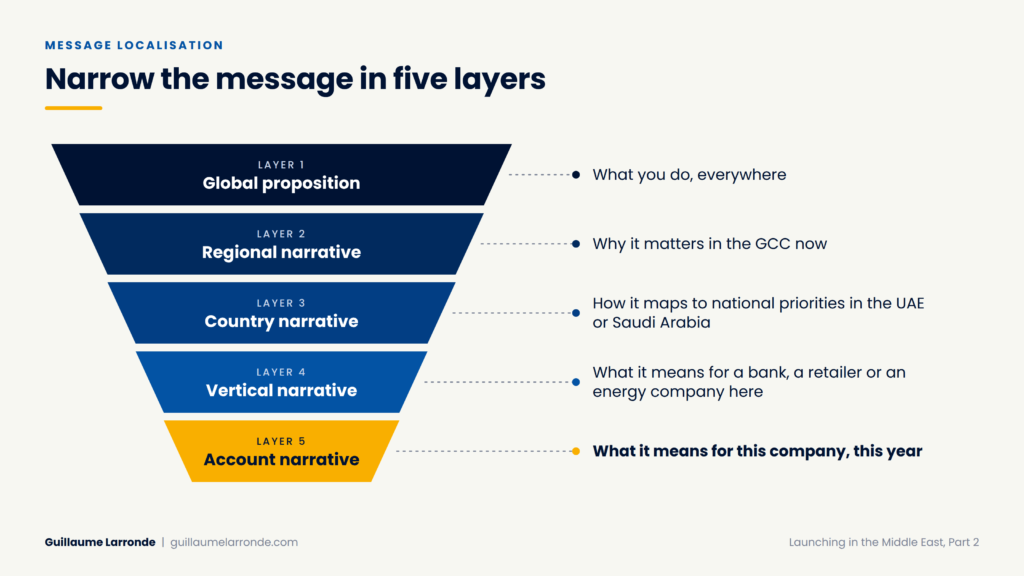
Messaging should narrow in five steps, each one more specific than the last:
- Global proposition: what you do everywhere.
- Regional narrative: why it matters in the GCC now.
- Country narrative: how it maps to national priorities in the UAE or Saudi Arabia.
- Vertical narrative: what it means for a bank, a retailer or an energy company here.
- Account narrative: what it means for this company, this year.
When I launched LinkedIn’s corporate offer in France in 2010, we were the challenger against a local incumbent with roughly 10x more French users. What worked was winning on the one use case the incumbent couldn’t serve. The same logic applies to message localisation: find the regional use case where you’re clearly the better answer, and lead with it.
Build GEO into the launch, not after it
A growing share of B2B research now happens inside ChatGPT, Claude, Gemini, Perplexity and Google’s AI Overviews. When a Riyadh CIO asks an assistant “which vendors do X for Saudi banks”, the answer cites pages that are clear, specific and verifiable. Regional competitors with thin websites are easy to beat here.
What makes regional content citable:
- Structured content: clear headings, short answer paragraphs, tables.
- Original research: even a small survey of regional buyers is rare and quotable.
- Clear entities: your company, founders, offices and customers named consistently.
- FAQs: answers to the exact questions regional buyers ask.
- Statistics with sources: every number linked and dated.
- Regional authority: local case studies, local speakers, local partners named.
- Case studies: problem, outcome, customer name where permitted.
This compounds. Content written in month three is still earning citations in year three, which is why it belongs in the launch plan.
Partners and lighthouse customers start the flywheel
Activate partners instead of collecting them
Signing partners is easy. Activating them is the work. Run every partner through seven steps:
- Identify: from your scored list in Part 1.
- Qualify: confirm customer access, capability and commitment.
- Contract: clear terms, territories and margins.
- Enable: training, demo environment, sales materials.
- Co-market: a joint event or content piece in the first 90 days.
- Co-sell: named accounts worked together, with a joint account plan.
- Measure: pipeline sourced and influenced, every month.
Then track one number: the activated partner rate. It’s the share of signed partners that have sourced or co-sold at least one qualified opportunity in the last 90 days. Signed partners are a vanity metric. A reasonable target for a startup: two of the first five partners active by month nine.
How to choose your lighthouse customers
A lighthouse customer is the one other buyers look at before they buy. Choose them on six criteria:
- Recognised brand: a name other GCC buyers respect.
- Strong ICP fit: they look like the customers you want next.
- Repeatable use case: what they buy is what others will buy.
- Measurable outcome: you can prove the result with numbers.
- Reference potential: they’ll take a call, speak at an event or sign off a case study.
- Expansion potential: there’s more to sell across divisions or countries.
Your first customer shouldn’t necessarily be whoever signs first. A fast yes from a poor-fit account can cost you six months of implementation and give you a reference nobody wants to call.
This is where the flywheel begins. The first Saudi client I closed at the agency mattered far more than its contract value. It was proof that the motion worked in a market the company had never sold into, and it made the next conversations shorter.
What does the real Middle East sales cycle look like?
The hidden Middle East sales cycle, step by step
Most forecasts get the GCC sales cycle wrong because the team counts the business “yes” as the finish line. In a Gulf enterprise, it’s roughly halfway.
| Step | What happens | Where it stalls |
|---|---|---|
| Business approval | The sponsor agrees to proceed | Sponsor lacks budget authority |
| IT review | Architecture and integration check | Integration with local systems |
| Security review | Questionnaires, pen test evidence | Hosting location, certifications |
| Data review | Privacy, residency, transfers | Data leaving the country |
| Legal | Contract negotiation | Liability, governing law, local terms |
| Procurement | Commercial negotiation, often competitive | Discount expectations, multiple quotes |
| Vendor registration | You become an approved supplier | Documents, local entity requirements |
| Finance | Budget release | Budget cycle timing |
| Purchase order | PO issued | Internal approval queues |
| Invoice | You invoice against the PO | Invoice format, e-invoicing rules |
| Payment | Cash arrives | Payment terms and approval chains |
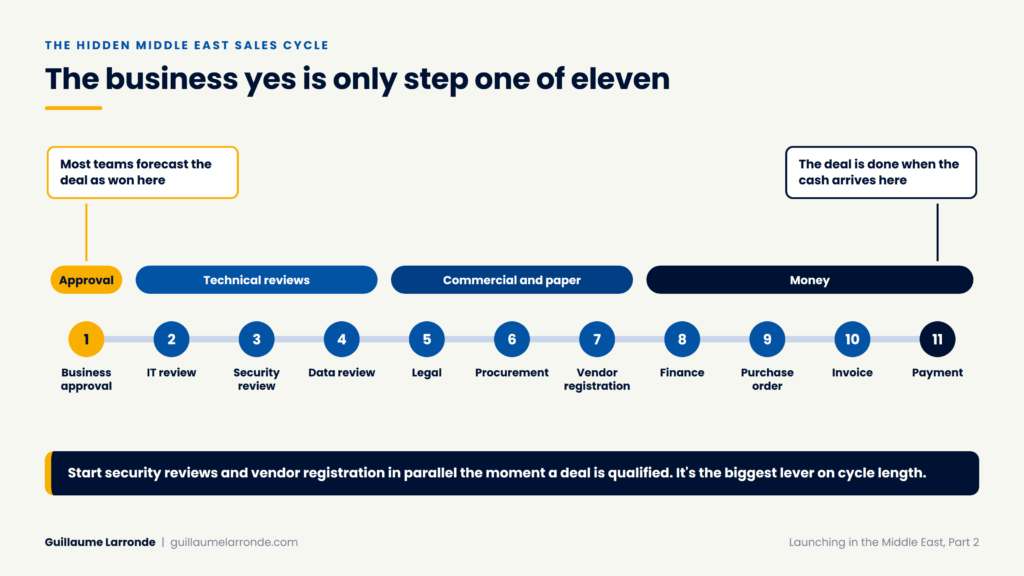
Start the security and vendor registration steps the moment a deal is qualified, in parallel, not in sequence. It’s the single biggest lever on cycle length.
Government and semi-government deals need their own motion
Government and government-linked entities are among the largest buyers in the region. They buy differently:
- Tender systems: formal tenders, often through government procurement portals such as Saudi Arabia’s Etimad.
- Vendor registration: a separate step, with document requirements, sometimes an in-country entity.
- Local content: some tenders weigh local content, local employment and local partners.
- Partners: many startups win their first government work as a subcontractor to a local integrator.
- References: government buyers often want public-sector references.
- Compliance: procurement rules are strict and fairness is monitored closely.
- Longer cycles: budget planning often happens a year ahead.
In Saudi Arabia, the Regional Headquarters rule restricts government contracting with multinationals that lack an RHQ in the Kingdom, with exemptions formalised in 2026. For a startup, the practical answer in year one is usually a local partner. Treat government as a separate pipeline with its own forecast, not as bigger enterprise deals.
Qualify hard and forecast from buyer evidence
Qualification as protection against false pipeline
Warm meetings and generous hospitality make Gulf pipelines look fuller than they are. A qualification framework is your protection. The choice of framework matters less than applying it without exceptions.
Use one of these consistently:
- SPICED: Situation, Pain, Impact, Critical event, Decision. Good for recurring-revenue sales and customer-centric discovery.
- MEDDPICC: Metrics, Economic buyer, Decision criteria, Decision process, Paper process, Identify pain, Champion, Competition. Good for complex enterprise deals.
- Mutual action plans: a shared document with the buyer listing every step, owner and date to go-live.
In the Gulf, five elements deserve extra attention:
- Economic buyer: have you met the person who signs, not just the one who likes you?
- Champion: will they spend political capital for you, or just take your calls?
- Decision criteria: written down, and agreed?
- Decision process: every approval step mapped, including regional or global HQ?
- Paper process: procurement, vendor registration and legal steps known with dates?
Forecast stages defined by what the buyer has done
Move the forecast from seller opinion to buyer evidence. Define each stage by a buyer action, not a seller feeling:
- Discovery: buyer confirmed a problem and a sponsor.
- Qualified: economic buyer met, decision process mapped.
- Solution validated: buyer confirmed fit in a demo, pilot or workshop.
- Commercials: buyer received and reviewed the proposal.
- Procurement and legal: buyer started vendor registration and contract review.
- Committed: PO process started with a date.
Then track five numbers every month: pipeline coverage, stage conversion, deal age, velocity and forecast accuracy. Counting calls and meetings to judge a pipeline is like weighing a suitcase to find out if you packed the right things. The number is real. It tells you nothing about the trip.
Customer success and customer stories are the other half of the flywheel
Customer success starts before signature
The flywheel only turns if customers succeed. In a new region, that starts during the sale:
- Pre-sale expectations: agree what success looks like, in numbers, before signing.
- Implementation: a plan with names and dates, shared with the buyer.
- Onboarding: in the customer’s working week and time zone.
- Adoption: usage tracked weekly in the first 90 days.
- Value: the agreed outcome measured and reported.
- Executive sponsor: a senior person on both sides who meets quarterly.
- Business reviews: quarterly, focused on outcomes, not features.
- Expansion: the next division, country or use case identified early.
- Reference: the ask made once value is proven, not before.
Turn the first customers into regional stories
Local references are commercial assets. Build each story in seven steps:
- Problem
- Deployment
- Adoption
- Outcome
- Evidence
- Story
- Advocacy
The story is step six, not step one. Without adoption and evidence, a case study is a press release.
One regional case study with a named GCC customer, a real number and a quote from a senior person can do more in year two than your entire global case study library. Get the permission to use the name early; approvals can take time.
Months 6 to 12: find the pattern, then double down
Where are we winning disproportionately?
By month six you have enough data to see patterns. Analyse every opportunity, won and lost, by:
- Country
- Industry and ICP tier
- Use case
- ACV
- Channel and partner
- Seller
- Sales cycle length
The question isn’t “are we winning?”. It’s “where are we winning more than our share?”. That’s the signal worth funding.
Stop what isn’t working, fund what is
Months 9 to 12 are about concentration. Be ruthless. An illustrative example of what the review might find:
- Saudi financial services converts; UAE retail doesn’t.
- Partner A sources pipeline; Partner B only asks for leads.
- Executive roundtables create deals; large trade-show stands don’t.
- Mid-size ACVs close in five months; large ACVs haven’t closed yet.
The action follows the data. Move budget and people toward Saudi financial services, Partner A and roundtables. Park UAE retail, Partner B and the big stand. Keep large ACVs as a watched bet with one owner.
Stopping things is harder than starting them, especially when someone senior championed them. Make the review evidence-based and it becomes easier.
The year-one dashboard and the four-outcome review
The year-one GTM dashboard
Keep the dashboard short enough to review in 30 minutes a month:
| Area | Metrics |
|---|---|
| Revenue | ARR, bookings, ACV |
| Pipeline | Total pipeline, qualified pipeline, coverage, sourced by channel |
| Conversion | Win rate, stage conversion, sales cycle, velocity |
| Forecast | Forecast accuracy against commit |
| Partners | Partner-sourced and partner-influenced pipeline, activated partner rate |
| Marketing | Marketing-sourced pipeline, cost per qualified opportunity |
| Efficiency | CAC, payback period |
| Customers | Adoption, retention, referenceable customers |
The last line matters most for the flywheel. The number of customers who’ll take a reference call is the best leading indicator of year-two growth.
Accelerate, iterate, maintain or exit
At month 12, make one of four decisions and write down why:
- Accelerate: the motion works and is repeatable. Invest in people and systems (see Part 3).
- Iterate: some things work. Fix the weak area and review again in six months.
- Maintain: the region is profitable at current size but doesn’t justify more investment yet.
- Exit: the evidence says the region won’t work for you now. Leave well, keep customers served.
Not every expansion deserves another $2M. Exiting on evidence is a good decision, not a failure. Staying on hope is the expensive one.
Frequently asked questions about launching in the Middle East
How long is the B2B sales cycle in the UAE and Saudi Arabia?
It depends on deal size and buyer type. Mid-market SaaS deals can close in a few months; enterprise and government deals often take six to twelve months or more once security, procurement, vendor registration and PO steps are included. Forecast from your own stage data after the first two quarters.
Should the founder sell personally in the Gulf?
Yes, in year one. Senior Gulf buyers expect to meet senior people, and early pricing, partner and product decisions need authority. A founder or executive in the region at least one week a month, owning the top strategic accounts and first customers, is the pattern that works.
Which events matter most for B2B tech in the GCC?
GITEX Global in Dubai and LEAP in Riyadh are two of the largest technology events in the region, but dates change, so check organiser sites. Measure pipeline per event dollar, book meetings weeks ahead, and consider smaller executive roundtables with a partner, which often create more pipeline than a stand.
Do I need partners to sell in the Middle East?
Not always, but they often speed access, especially for government and large enterprise deals. Sign few partners, activate them with joint account plans and co-marketing, and track the share that sourced or co-sold qualified pipeline in the last 90 days. Signed but inactive partners are a vanity metric.
What should a startup achieve in its first year in the GCC?
Evidence more than scale: a validated ICP, three to five lighthouse customers, a measured sales cycle, pricing that holds, at least one activated partner, and referenceable customers. With that evidence, month 12 becomes a clear decision to accelerate, iterate, maintain or exit.
Launching in the Middle East is an evidence-building exercise that happens to produce revenue. Treat it that way and the second year gets easier every month.
Read Part 3: Scaling in the Middle East for how to turn year-one evidence into a repeatable regional engine, or go back to Part 1 if the account list doesn’t exist yet.




One Comment